
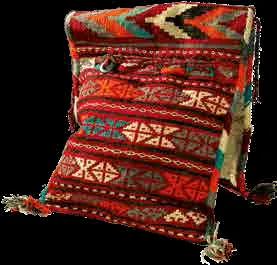
This type of craft was especially widespread among the Kungrat of the Dekhkanabad (Kashkadarya) and Boysun (Surkhandarya) regions, and produced the following basic goods: flat-woven and pile carpet items woven using the gajari technique, kohma, takir; emroidered carpets, julkhyrses, short-pile gilams and felt. Among other in-demand goods were napramaches, horsecloths (digil or digdigya jul), bugjoma, khurjuns, napramaches, dastarkhans, joynomazes, ishlik-khalta and koshik-khalta bags. Machines were either horizontal or narrow-beam, and could handle lambswool or cotton yarn.
Dyes at first were natural (madder, timber fungus, oleaster root, etc.), but starting in early 20th century were switched to aniline. Kungrat carpets were woven with rather conservative technology and decorations. Such steady traditions were related to the idea of nasil buzilmasin – “not to spoil the family”, which embodied a rejection of mixed marriages and strict adherence to the consistent preservation of cultural origin. All throughout the 20th century, Kungrat carpet weaving developed at a fair pace, which was connected with the fact that the Kungrat still kept to their stock-raising way of life and adhered primarily to family culture and traditions. Nowadays, the Kungrat are the main producers of handicraft carpet items. The Uzbek Lakai were a large tribal community. Just like the Kungrat, the Lakai were one of the Dashti-Kipchal tribes. But starting in late 19th century, according to B. Karmysheva, they merged to become part of the Katagan tribal community (the majority of this tribe lived in their yurt, Kunduz). The Lakai practiced distant-pasture cattle rearing in combination with agricultural farming, thus preserving their tribal integrity and political independence. When the Emirate of Bukhara was established, the territories of the Lakai including the vast grasslands of mountain Valleys in South Uzbekistan and Tajikistan, as well as the regions around Balkh and Kunduz in North Afghanistan, became part of the state.
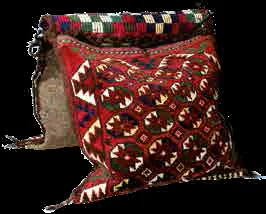
When the Soviets came, part of the Lakai remained in North Afghanistan (Kunduz region), but the larger part of them settled on the northern bank of the Amu Darya in Tajikistan, and became accustomed to the kolkhoz way of life. Nowadays, the Lakai of Tajikistan preserve their origins as an Uzbek ethnic group. The Lakai mainly produced thin embroidered rugs that differed from the items of all other tribal communities (except for the Kungrat, who made similar goods), as well as various yurt straps and bags for household items (mapramach) and felt carpets with applique. The pile technique was used mostly for the front parts of bags. Carpets were woven on a horizontal machine in the form of separate, non-decorated straps, after which the finished straps were then embroidered and sewn together into a single cloth. Lakai carpets and famous embroidery are dominated by prevailing intense and vibrant red colors.
Nowadays, the carpets of this ethnic group are the jewels of many private and state museum collections all over the world. They entice the viewer with their original features, where a seemingly primitive pattern might instead actually contain magical powers and mysterious images.
You can learn more about the topic in the book-album "Carpet making of Uzbekistan: A tradition preserved through centuries" (Volume XIV) in the series "Cultural Legacy of Uzbekistan in the World Collections".
The main sponsor of the project is the oilfield services company Eriell-Group.