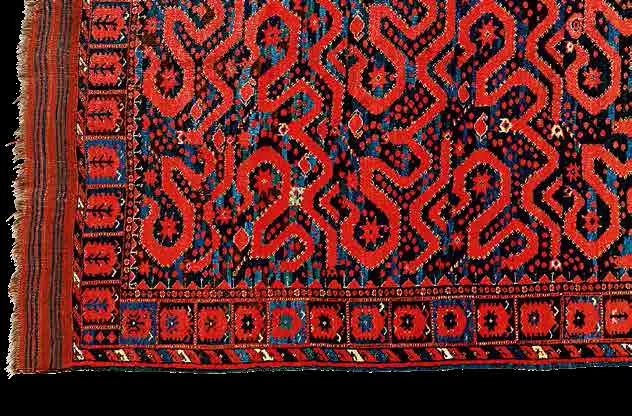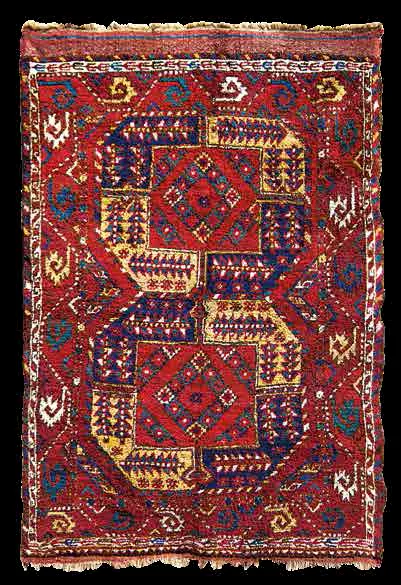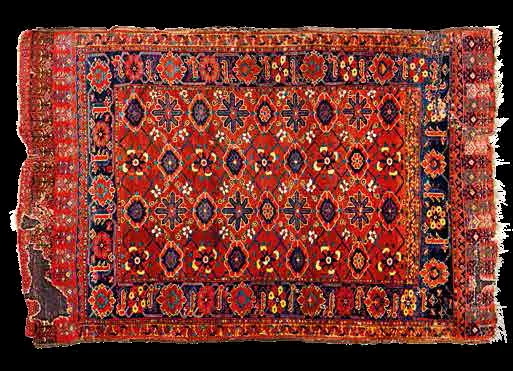
Market needs in carpet goods were satisfied in large part by Turkmen, while the remaining tribal communities wove carpets for their own homes. We will pay special attention to goods from Karakalpak people, who made carpets for the decoration of yurts. Small esik-kas carpets decorated the upper part of the yurt door from the inside, while woven straps such as ak-baskur, ak-kur, kyzyl-baskur, kyzyl-kur, zhambau, dizbe and others held the yurt’s frame together, and at the same time decorated it inside and out. Small covering rugs and karshin utility bags (bag for clothes, an analogue of the Uzbek napramach) also decorated the interior of stock rancher homes.
The pile carpets of Karakalpaks, along with those of Turkmen, contain dominating features such as medalion-gol, with a distinctive diagonal pattern. But unlike Turkmen items, Karakalpaks’ gols have simpler patterns, and there is no discernible tribal meaning. All in all, Karakalpaks’ carpets are decorated in a very concise manner, with the following elements dominating: simple and stepped diamonds, squares, octangles, triangles, zoomorphic (horn and claw-like), S-signs, and broken lines, i.e. the most archaic elements typical for steppe art and a feature of all carpets made by peoples who used to lead a nomadic existence. Semi-abstract plant motifs like the tree of life can be seen on yurt straps, or baskurs. The palette is based on a contrasting combination of red, brown and black (main) shades. By varying the ratio of colors and their shades, women managed to achieve a variety of artistic solutions.
The most original group of Karakalpaks’ items was made using both pile and flat-woven weaving techniques. The unique aesthetic effect achieved through this combination makes these items stand out among all other varieties of Central Asian material. A white background with a cotton base is set against and combined with a pile pattern in red and brown. In the 20th century, carpet weaving gradually began to decline in the region.
You can learn more about the topic in the book-album "Carpet making of Uzbekistan: A tradition preserved through centuries" (Volume XIV) in the series "Cultural Legacy of Uzbekistan in the World Collections".
The main sponsor of the project is the oilfield services company Eriell-Group.