
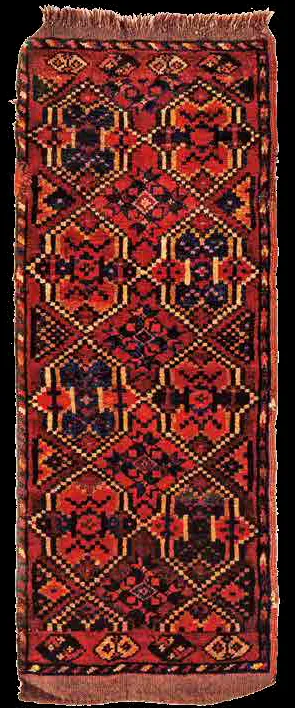
The majority of the population was settled in cities and villages (Tajik and Uzbek who had already transitioned to a settled way of life), while the rest, such as livestock herders, preserved their nomadic traditions (the Uzbek Ming, Tyurk, Yuz Kungrat, Kipchak, as well as the Kyrgyz, Karakalpak and Kazakh). Carpet weaving in the Khanate was developed mainly among semi-nomadic tribal groups. Carpets woven by the Kyrgyz have been preserved the best throughout history. They wove flat-woven rugs such as terme, gajari and besh-kashta; eshik tysh and joinamazes, various bags, such as chavadons (Uzbek analogues: napramach and karchin), bashtyks, ayak koychu and kosh jabyk, khurjuns, and eger kyopchyuk saddle rugs. They were also fond of small pile carpets called gilams (gilem, kilem), along with decorative tegirich yurt carpets. The machine (dukon) they preferred was horizontal, and they used lamb and camel wool, cotton (for the base), and sometimes silk (to contour the pattern). Obvious steppe traditions can be discerned in the pattern, which predominately featured elements such as geometrical, horn-shaped and claw-shaped details, images of tumor amulets, astral symbols, and taman motifs (traces of spirit animals).
Madder red and brown shades combined with blue indigo were the most frequent colors. Since the late 19th century, when the territory of the khanate had already become part of the Turkestan General Governorship, carpet weaving in the Valley became commercial. And while for household needs the Kyrgys still wove small items, they also began making large carpets, or saray kilem (“palace carpets”), for sale. Such a name was given on purpose, as the Kahanate court in Kokand was among the consumers25. As their work transitioned to the commercial market, Kyrgyz women relied heavily on the patterns of imported Iranian, Azerbaijan and East Turkestan carpets, as well as Bashir carpets (Turkmenistan), using them as the basis to create their own variations. A part of the Uzbek and Kyrgyz population lived in the Sintszyan-Uyghur autonomous region, namely the cities of Kashgar, Yarkend and Khotan. It is therefore quite natural for Kyrgyz weavers to have adapted Uyghur patterns.
Among the typical Kashgar motifs are kashgar-nuska, or a pomegranate bush (anor), large round medallions (Buddha’s Lotus), and a motif in the shape of a mushroom-like cloud, also known as chji, which was most often placed along the perimeter of the central carpet space. Carpets like kashgar-nuska quickly gained prominence in the Fergana Valley.
You can learn more about the topic in the book-album "Carpet making of Uzbekistan: A tradition preserved through centuries" (Volume XIV) in the series "Cultural Legacy of Uzbekistan in the World Collections".
The main sponsor of the project is the oilfield services company Eriell-Group.