
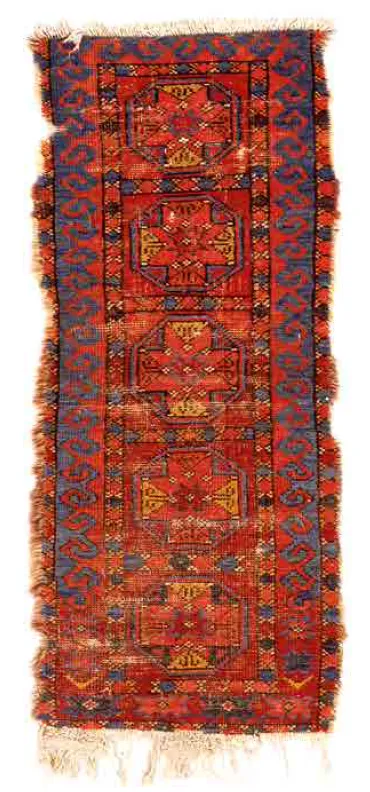
The Uzbek from Samarkand, Nurata, Kashkadarya, and Surkhandarya regions, the Karakalpaks and the Syr Darya Kazakhs made carpets mostly for their own needs.
The main goods from this region were julkhirs, gilam (patly gilam) sheared carpets and almost all types of flat-woven carpets, household goods. The material used was wool, and from late 19th century cotton yarn was also often used for the base.
Short-pile small rugs – gilams – were woven first on narrow-beam, and later on widebeam machines. According to V. G. Moshkova, “the production of solid-woven carpets had only been developed here quite recently”. Other old flat-woven items are also sometimes made from silk, mainly horsecloths.
Carpets were of dark shades due to the characteristics of local wool that made it difficult to color them with lighter dyes. All in all, items from the Samarkand group were characterized by the fine quality of wool, high weaving density, precise geometrical patterns and balanced colors.
By the 1870s not more than 25 % of the Uzbek semi-nomadic population practiced carpet weaving, and by the 1930s, pile weaving was almost entirely a thing of the past. Flat-woven weaving shrunk in size, and in the 1920s only kohma was still being produced. Skilled women started to forget pattern names (instead they used technical descriptions like “with seven threads”, or “with four threads”). All throughout late 20th century carpet weaving in the Samarkand and Jizak regions was all but disappearing.
You can learn more about the topic in the book-album "Carpet making of Uzbekistan: A tradition preserved through centuries" (Volume XIV) in the series "Cultural Legacy of Uzbekistan in the World Collections".
The main sponsor of the project is the oilfield services company Eriell-Group.
_1_1.webp)