
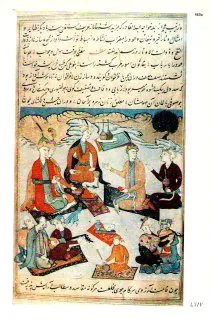
The typical features of the musical culture of that epoch include universalism; an expanding sphere of professional musical activity; the co-existence and interaction of secular and religious tendencies; democratization of the forms of music distribution; availability of scientific knowledge about music; a highly-developed culture of emotional and aesthetic perception of music; synthesis between the Persian and Tajik, and Turk and Uzbek traditions.
The striving for musical and even artistic universalism was encouraged by patrons of music, and gradually became a part of their cultural life. Oftentimes musicians would play several instruments, or both sing and play simultaneously. They also combined performing with writing, created plays in different genres and even combined creative and scientific thought expressed in a variety of scientific treatises on music.
The number of professional musicians increased dramatically in this period. An unknown author of that epoch even compiled a special list (which is now preserved in the National Library of Paris), conditionally titled in the catalogue as “The List of Musicians Who Lived in the Epoch of Sultan Husayn Bayqara”. One of the features of that time was the inclusion of brief biographies of musicians in memoirs and historical, poetic and other works, especially in the anthologies of poets from the second half of the 15th – 17th centuries. Among s everal dozen musicians, we c an also name about a dozen of those mentioned by almost all their contemporaries. There were roughly fifteen musicians serving under Zahir al-Din Babur.
The majlis remained the main forum of musical performance in public. They were held not only in the palace of Husayn Bayqara and famous personalities of the era, but also in the homes of poets and musicians. The majlises organized by Alisher Navoi, ‘Abd al-Rahman Jami, Sayyid Hasan Ardasher and Pahlavan Muhammad Kushtigir in Herat were especially outstanding.
You can learn more about the topic in the book-album "The Musical Legacy of Uzbekistan in Collections of the Russian Federation" (Volume VI) from the series "Cultural legacy of Uzbekistan in the world collections".
The general sponsor of the project is the oilfield services company Eriell-Group.