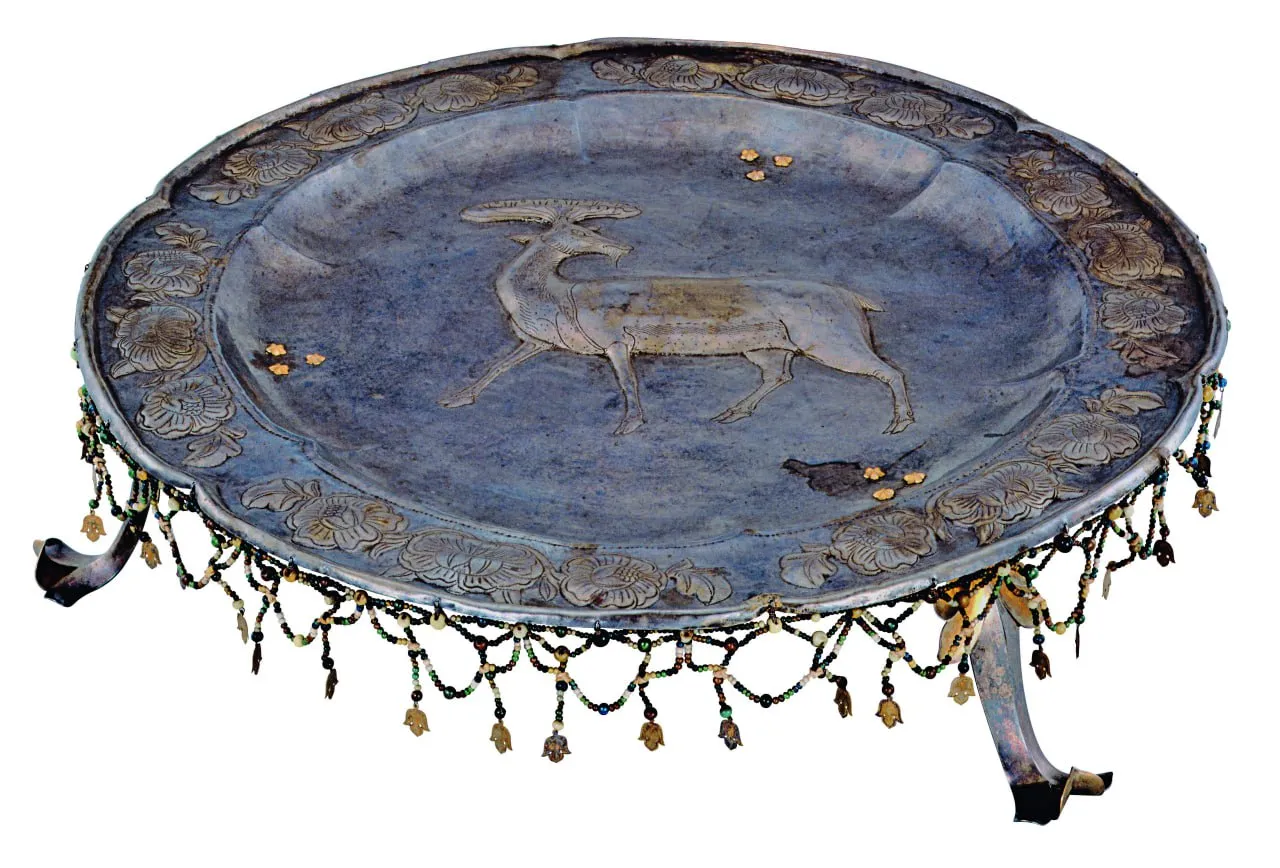
Similar platters have been found in different parts of China. Among them there are specimens exceeding 80 cm in diameter, while the average diameter, currently known, is from 30 to 40 cm. Thus, the dish from Shosoin deserves special attention.
On the back side of the dish there are engraved inscriptions: “One dish with number of “y” sign, 2 shaku in size, weighing 105 ryo and 4.5 sen”; “A dish with an ornament of flowers for Todaiji temple, weighing 6 kin 8 ryo.” The number of the sign “y” indicates the fifth number, according to the Chinese poem “Senzimon.” Based on this detail, we can assume that it was made in China. The second inscription indicates that the dish belonged to the Todaiji Temple. Thus, the place of manufacture of the present artifact is Tang China. From there the dish was brought to Japan, where it became a property of the Todaiji Temple, and then it was transferred to the Shosoin treasury.
Although the purpose of the dish is not known precisely, it is possible that it was used for offerings to the Great Buddha Statue. Nowadays, similar items are used simply for interior decoration. However, during the Nara period in Japan, such items were not for a decorative purpose, rather they were used as one of the types of ritual utensils for the offerings for the Great Buddha Statue. Among dishes with floral decorations found in China, there are other specimens with the image of an animal in the center.
You can learn more about the topic in the book-album "Cultural legacy of Central Asia in Japanese Museums" (volume XX) in the series "Cultural Legacy of Uzbekistan in the World Collections".
The main sponsor of the project is the oilfield services company Eriell-Group.