
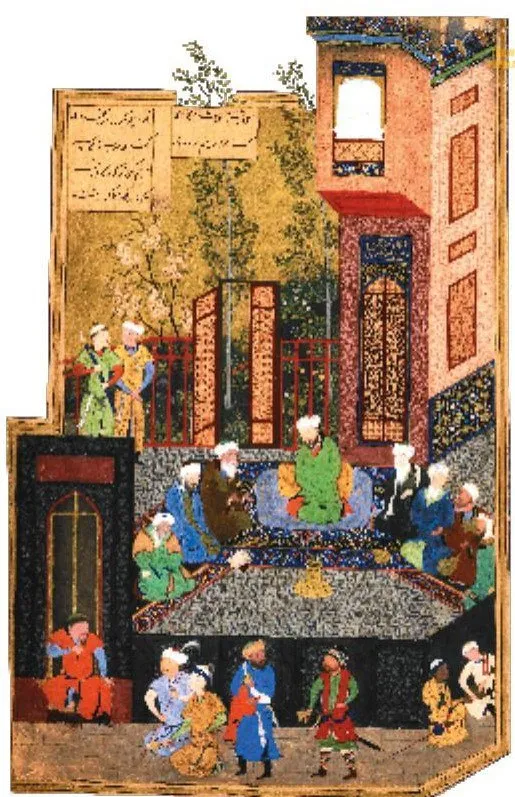
This is a popular plot in the illustrative cycle of the poem telling about Iskandar, who in the eastern tradition of the history of the Greek commander Alexander the Great was considered not only a successful warrior, a just king, but also a philosopher. In this miniature, Iskandar invites famous sages to an interview about the secrets of the creation of the world: Aristotle, Valis (Thales of Milesian), Socrates, Bulinas (Apolonius of Tyana), Furfurius (Porfiry of Tyrian), Hermis (Hermes Trismegistus) and Plato. The scene is given, as always with Behzad, in terms of genre. The conversation takes place in the atmosphere of the royal court, in front of the wonderfully decorated palace building, where the participants of the meeting are sitting on carpets, fenced on one side by a wall, and on the other by a light fence with a gate opened into a blossoming garden. The gray-bearded elders settled down on the sides of the king. Together with the figures behind the fence – wandering dervishes leaning against the wall, a shepherd, a merchant with a red robe in their hands, and two petitioners – the king and the sages form a circle, in the center of which is a vessel with a closed lid, symbolically indicating the philosophical content of the conversation.
The figure of Iskandar in a green robe, humbly crossed his lowered sleeves, and his facial features are familiar from many images of Sultan Husayn. His figure stands out among those present – he sits on a kurpacha and leans on a pillow, thereby emphasizing his regal grandeur and the right to be present among prominent scholars as the initiator of the meeting.
This illustration belongs to Kamal ud-din Behzad, the great miniaturist of the East, and the landscape genre occupies a special place in his work. The illustration is currently kept in the British Library.
The thing that is especially worth mentioning in Behzad’s work is the landscape. Like Sufi pantheist poets, Behzad looked for analogies in material nature, which served as means, images, concepts for conveying the idea of the unity of humansand nature. A golden hill against a blue background of the sky, gently colored peaks of heaping rocks, their bizarre drawing, – in each case he painted a landscape that was consonant with the psychological mood of the depicted event, the state of the hero’s mind and the style of the illustrated poetic work, creating with the general planar solution of the miniature an illusion of a huge space through smart coloring and skillful arrangement of figures. In his works, the landscape is a part of the endless and beautiful macrocosm created by God (“Layla and Majnun in the Desert”, A. Kh. Dehlavi, 1490, RNB, Dorn 394), “Iskander Visits a Hermit in the Mountains” (Nizami, the Khamsa, the British Museum).
You can learn more about the topic in the book-album "The legacy of Kamal ud-din Behzad in the World Collections" (L volume) in the series "Cultural Legacy of Uzbekistan in the World Collections".
The main sponsor of the project is the oilfield services company Eriell-Group.
Main page//The Great Iskander from Greece and Aristotle, Sacrates, Plato: what is the connection between them?
The Great Iskander from Greece and Aristotle, Sacrates, Plato: what is the connection between them?
Pay attention to this illustration for the last poem of the Khamsa by Nizami, Iskander-nama, for its second part Iqbal-nama.