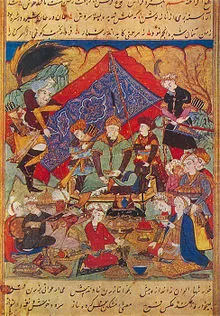
Many cities were destroyed, and a severe economic crisis ensued. Only in the XIV-XV centuries, with the Amir Temur`s appearance on the political arena, who revived the country and created a huge empire, the peoples of Central Asia again embarked on the path of creation. This time is marked by the revival of cities, architecture, arts, poetry, book miniatures and crafts. Crafts such as ceramics, the manufacture of fine fabrics and rich embroideries, chased vessels, weapons, and jewelry flourish.
The spiritual and material heritage of this era is one of the brightest pages in world history. The brilliant rise of sciences, urban planning, fine and applied arts, literature, poetry, music, performing arts is a unique phenomenon on a global scale, which has not been accidentally called the “Temurid Renaissance”.
Decorative ornamentation reached virtuosity during this period. The pattern was dominated by floral ornaments and expressive inscriptions. Calligraphy dominated in coinage, glyptics, metal carving. All patterned compositions with floral and epigraphic ornaments surprisingly obeyed the forms of products, their divisions. Closed in geometrized fields, borders, stripes, the ornament created a feeling of continuous movement, infinity, and at the same time steady calm.
You can learn more about the topic in the book-album "Collection of the Samarkand State Museum-Reserve" (Volume XVIII) in the series "Cultural legacy of Uzbekistan in the world collections".
The main sponsor of the project is the oilfield services company Eriell-Group.