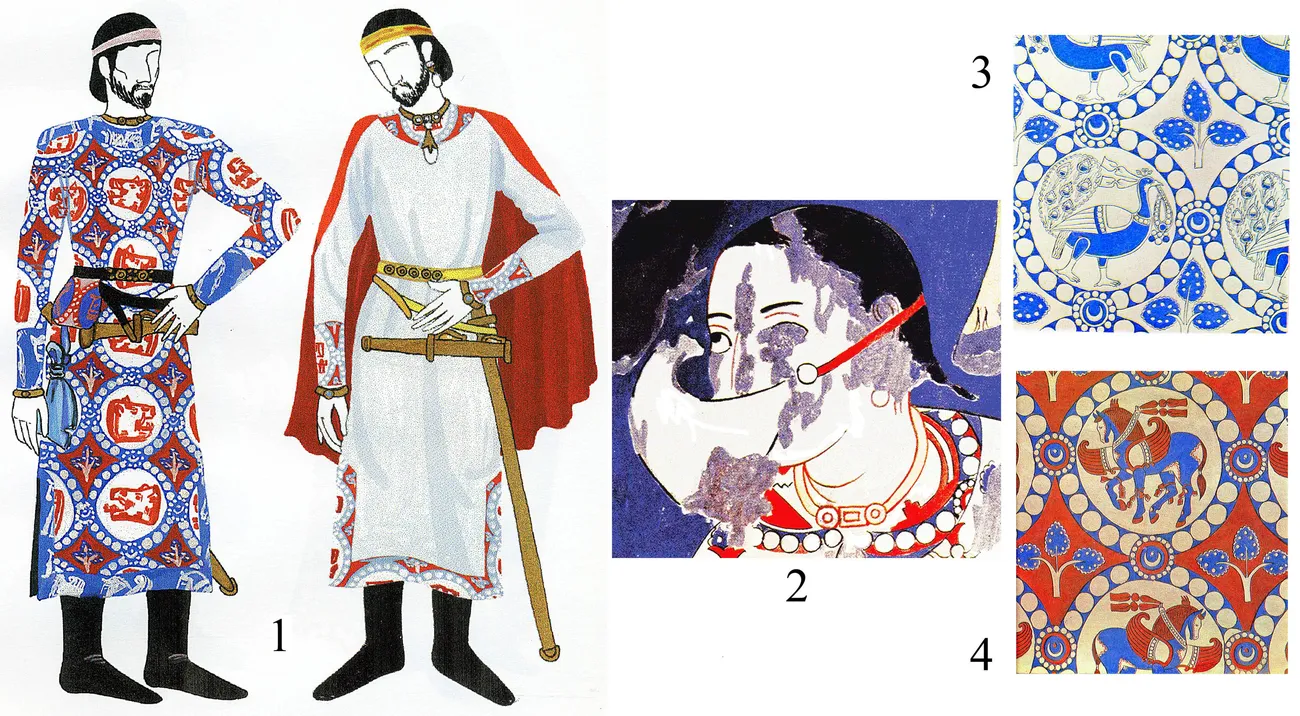
In the VII–VIII centuries, the ideal of beauty for both sexes was rather narrow clothes, emphasizing the figure.Large items of clothing (shirts, dresses, trousers) usually had a basic background of red, white or yellow. The most expensive and fashionable multicolored silks with complex patterns or from several shades of the same color (imported and Sogdian) usually form a border around the edges; only rarely do sovereigns and families of the highest nobility have clothes entirely made up of them.
Hats were very diverse. For men, the most popular was felt, less often – a fabric high conical cap, often with a lapel and slits along the bottom edge. A specific Sogdian was also a special a headdress in several variants, apparently imitating a combat helmet, with a top in the form of a long tubular cone.
Both sexes wore a variety of hats with a high crown. The ruler of Samarkand had a hat with a lot of gold jewelry and precious stones; another variant of the ruler's headdress was a golden diadem with seven expensive stones. Noble ladies covered their hair with a black handkerchief embroidered with golden flowers or an openwork hairnet. Young women and girls wore four braids of different lengths; the hairstyle was often decorated with bows.
You can learn more about the topic in the book-album "Sogdia: the heart of the silk road" (volume XXXV) from the series "Cultural legacy of Uzbekistan in the world collections".
The general sponsor of the project is the oilfield service company Eriell-Group.