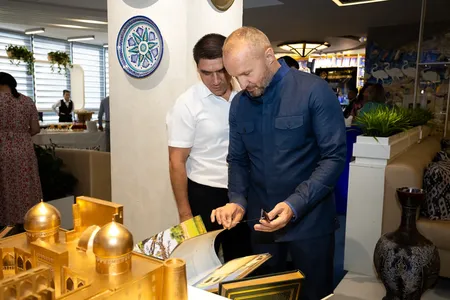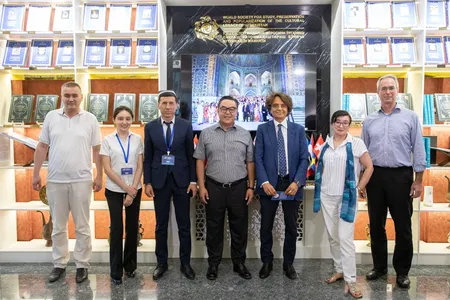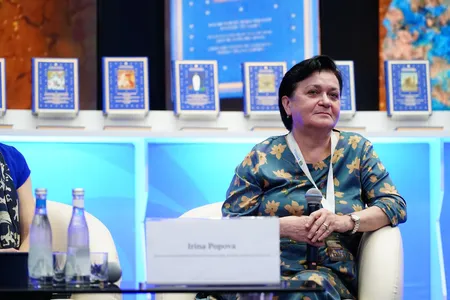
On July 3-7, 2023, the International Partnership Initiatives Week titled "New Uzbekistan: Development, Innovation and Education" was held in Uzbekistan. It was initiated by the World Society for the Study, Preservation and Popularization of the Cultural Legacy of Uzbekistan and organized in cooperation with the Ministry of Culture and Tourism of the Republic of Uzbekistan and a number of other ministries and departments. As part of this week, an exhibition and a round table titled "Historical figures and plots in the masterpieces of the manuscript heritage" were organized in the Event Hall, which had been built on the territory of the Cinematography Agency.
This was the subject of our interview with Firdavs Abdukhalikov, Chairman of the Board of the World Society for the Study, Preservation and Popularization of the Cultural Legacy of Uzbekistan and Director of the Cinematography Agency.
_8.webp)
"What was the purpose of the exhibition 'Historical figures and plots in the masterpieces of the manuscript heritage of Uzbekistan' organized within the framework of the Week?"
"Interest in Oriental culture, including miniature art, has always been high all over the world. Currently, oriental miniatures depicting historical figures are stored in various regions of the world, in museums and libraries, research institutions, private collections.
In recent years, the Government of Uzbekistan has been paying great attention to miniature art and its development: exhibitions of copies of national miniatures stored in world collections, museums and libraries are being organized, books and albums are being published. Not only relevant ministries and departments are actively involved in this good cause, but also non-governmental, non-profit organizations and socially responsible businesses. In particular, a number of activities are implemented by the World Society for the Study, Preservation and Popularization of the Cultural Legacy of Uzbekistan. More than ten books-albums from the Cultural Legacy of Uzbekistan series are directly related to the art of miniature painting. In addition, a book-album titled Kamoliddin Behzod That Shamed Mani was published last year. Facsimiles of such rare manuscripts as Zafarname, Hussein Baykara's Diwan, Mirajnameh, Ravzatus Safo and The Book of Fixed Stars have been created.
Although issues related to the interpretation of medieval miniature art and historical figures have been discussed in research papers, no separate studies on this subject have been conducted, and historical figures in miniature art have not been published on a systematic basis.
So the Historical Figures and Plots in the Masterpieces of the Manuscript Heritage we are currently preparing would be the first book-album dedicated to this subject in Uzbekistan."
"There is an opinion that symbolism and convention should be in the first place when depicting historical figures in miniature. Can we say that they reliably represent the images of historical figures?"
"The depiction of historical figures requires a realistic approach from an artist. Although an artist relied on his imagination when depicting historical figures, he was to reflect the external structural features of a prototype.
For example, the work Chor Makola by Nizami Aruzi Samarqandi says that Mahmoud Ghaznevi was looking for the famous scientist and judge Abu Ali ibn Sina all across the country, for which purpose he ordered that famous artists paint 40 copies of the person's portrait and sent them to different regions of the country.
Although these portraits have not come down to us, there is an extant portrait of Ibn Sina painted in the middle of the 15th century for the book Chor Makola. It depicts Ibn Sina treating the nephew of the ruler of Gelan.
The image of Ibn Sina is based on the imagination of that time. He is sitting next to the patient lying in front of the table, pointing to a medicine with his hand. Ibn Sina is depicted in all miniatures with a long white beard, a large hooked nose and bushy eyebrows."
"It turns out that the exhibition features a portrait of Jalaliddin Manguberdi, which was made in the Middle Ages."
"The image of the great commander Jalaliddin Manguberdy can be found in medieval miniatures. Historian an-Nasawi described Jalaliddin as 'of medium height, strong, dark-faced.' Two miniatures of Genghis Khan and Jalaliddin have come down to us. The first miniature is taken from the work Tarikhi Abulkhaykhoniy rewritten in Samarkand during the Sheibanid period. The painting was made by an unknown artist. In it, Jalaliddin can be seen on a riverbank, looking straight and proudly at an enemy.
The second painting was created in India in the 1600s during the Baburid period. This painting from the work Genghis Khan-nameh depicts Sultan Jalaliddin crossing the Sindh River on horseback. In the works created in both periods, Jalaliddin surprises his enemies with his courage and heroism. This suggests that during the Sheibanid period and at the Baburid court, Jalaliddin was considered a symbol of bravery and courage."
_INLzPJK_8.webp)
"The image of Amir Temur can be found on miniatures made in different periods. However, most of them show lack of uniformity."
"We know that the image of Amir Temur in the Soviet years became a symbol of evil, aggression and oppression. School students learnt about Amir Temur from textbooks offering a visual reconstruction of his image by M. Gerasimov, who followed the political ideology of his time and depicted Amir Temur as ferocious and terrible as possible. However, miniatures present Amir Temur as bright, sincere, resolute and intelligent.
Amir Temur enjoyed great attention from his contemporaries and subsequent generations. Rui Gonzalez de Clavijo, who was ambassador to Amir Temur, provides valuable information about the appearance of the ruler, as well as a number of historical figures at that time, in his work The Narrative of the Embassy to the Court of Amir Temur.
It is believed that one miniature, which dates back to the late 14th-early 15th century, was made during the lifetime of Amir Temur. This portrait also subtly shows the physical shortcomings of Sahibkiran. It is known that Amir Temur was wounded in the leg in a battle in Seistan and became disabled for the rest of his life. In this portrait, the ruler is depicted sitting with a wounded left leg tucked under him. Thus, the artist showed that Amir Temur lame.
The work Zafarnameh written by Sharafuddin Ali Yazdi after the death of Amir Temur is a historical work dedicated to the activities of the military commander. In different copies of this work, we can see dozens of miniatures of Amir Temur in different situations."
"It turns out that the appearance of Mirzo Ulugbek is also different from what we imagined..."
"So far we have identified two portraits of Mirzo Ulugbek, painted during his lifetime. The first of them is an image in the manuscript of Abdurrahman as-Sufi's The Book of Fixed Stars, rewritten in 1437 following a personal order from Mirza Ulugbek. The image drawn for the constellation Cepheus is very similar to Mirzo Ulugbek. On the page, the ruler is depicted on the dome of the sky, wearing a white cap with a canopy on his head and without shoes.
Another portrait depicting Mirzo Ulugbek during his lifetime is kept at the Freer Art Gallery in Washington. In the upper part of the painting you can see the inscription "the greatest Sultan Ulugbek Kuragan, may God make his reign eternal." This sentence alone is the basis for the conclusion that the picture is connected with the life of the ruler.
The features common to both images are mostly visible in the headdress. The white headdress of the ruler resembles a hat with an umbrella. In three parts of the hat there is an “ukpar” typical for kings. In both paintings, the outerwear is blue. The facial features in the images are also very similar."
"Speaking of oriental miniature, it is impossible to forget the name of the great artist Kamoliddin Behzod."
"Miniature art developed in Herat during the reign of Sultan Hussein Baykara, as well as by his close friend, poet and thinker Alisher Navoi. Behzod was also a talented representative of this period. The famous Portrait of Sultan Hussein was created in 1490 and is now kept in the Harvard University Museum in Cambridge.
In 1490-1495, Behzod, in the illustrations for the work Hamsa by Nizami, depicted Sultan Hussein as famous historical and literary heroes. In it, the sultan is depicted as the great Macedonian commander Alexander, who was famous for his justice, wisdom, and courage, characteristic of a true warrior.
Behzod repeatedly turned to the image of the great poet Alisher Navoi and depicted him in a garden with a cane in his hand. In this position we see him in a portrait by the Bukharan artist Mahmud Muzahib, who lived in the 16th century.
In Behzod's miniature Construction of the Mosque, which was painted for the work Zafarnameh, Navoi is depicted as Amir Temur watching the construction. In the miniature Dance of the Sufis by this artist Navoi wears blue clothes. This portrait, painted during Navoi's lifetime in Herat, is now in the Metropolitan Museum of Art in New York.
Another portrait of Navoi, inspired by the work of Kamoliddin Behzod, is Alisher Navoi and Sultan Muhammad Mirza. It is believed that this painting was created by Qasim Ali in Tabriz in 1540 and is currently kept in the Topkapi Museum. In many of his works, Behzod tried to copy the images of his contemporaries, such as Hussein Baykara, Alisher Navoi, as well as historical figures, such as Iskander (Alexander), Sultan Sanjar, Khurmuzd and Amir Temur. This situation can also be seen in the miniature Iskander (Alexander) and the Seven Sages, which was made for the work Sharafnameh from Nizami's Hamsa. In this miniature, Sultan Hussein is depicted as the famous historical hero Alexander.
Behzod had a great influence on the development not only of the Temurid miniature schools, but also the Safavid, Osmanid, Sheibanid and Boburid ones. Behzod grew up at the Temurid court, under the patronage of Hussein Baykara and Alisher Navoi, and later received honor and respect in the palaces of Sheibanikhan and Shah Ismail Safavi. According to sources, the Safavid ruler Shah Ismail kept Behzod in a special cave surrounded by guards so that the Ottomans would not take him to Istanbul.
Currently, Behzod's miniatures are kept in various museums, private collections and libraries around the world."
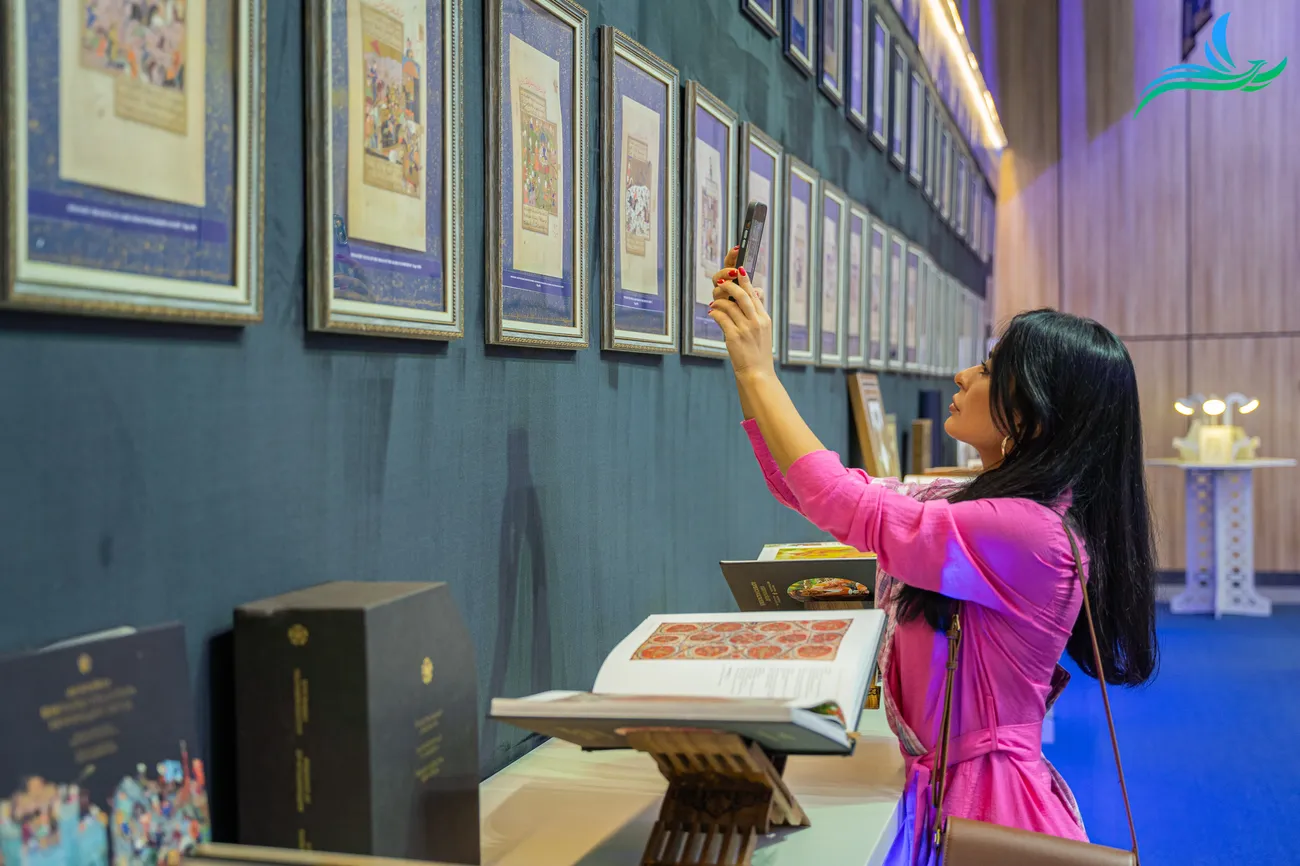
"The miniature is history. What can you say about its relevance today?"
"In the 20th century, Uzbek artists often turned to the images of scholars, poets and artists. Among them are a portrait of Navoi by Kaidalov, The Youth of Hussein Boykara and Alisher Navoi by Javlon Umarbekov, Kamoliddin Behzod with Students by Reich, a portrait of Mirzo Ulugbek by Chingiz Akhmarov, Amir Temur by Malik Nabiyev, as well as works by Akmal Nur, Aziz Mamatov, Niezali Kholmatov and others. We can also find images of our great ancestors in the works of our contemporary artists. Of course, in their works they used miniature art as examples.
Miniatures are also very useful when creating historical films. They are a valuable source for reconstructing historical costumes, battle and construction scenes, banquets, meetings and everyday environments. Currently, miniatures are effectively used in documentaries, animated and feature films ordered by the Cinematography Agency. In particular, miniature art plays a very important role in the feature film Jami and Navoi, which is being filmed by cinematographers of Uzbekistan and Tajikistan.
Taking this opportunity, I would like first of all to thank the Ministry of Culture and Tourism, which has cooperated with us in holding the Cultural Heritage Week, and all scholars and specialists who rendered great help in this matter, in particular, PhD in Art Studies Zukhra Rakhimova, Director of the Abu Rayhon Beruni Institute of Oriental Studies Bahrom Abdukhalimov, Director of the Institute of Oriental Manuscripts, Russian Academy of Sciences, Irina Popova, French orientalist Frances Richard, and vice-president of the Mueller and Shindler publishing house Alexander Wilhelm."
"Thank you for the informative conversation."
Interviewer R. Jabbarov