
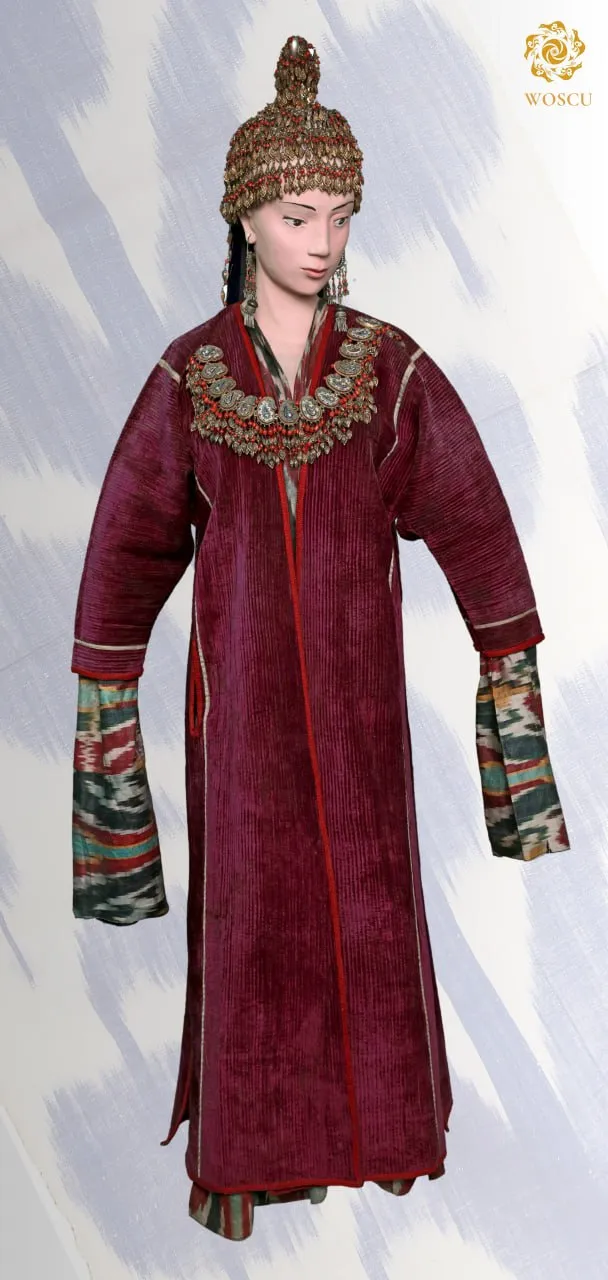
Both men’s and women’s clothing had a common basis – a wide, tunic-shaped shirt and outer coat. The style remained almost unchanged, only the fabrics changed, the methods of their decoration, the length and width of the clothes, and accessories.
Women’s outer clothing consisted of several varieties of light robes (delegay, rumcha, mursak, kaltacha) and a warm, quilted chopon on cotton wool. One of the most common varieties of women’s robes was mursak or munisak – clothing long to the ankles, with long sleeves. It was without a collar, gussets, and the sides of tyrez under the sleeves were gathered in folds of a pile, fastened in a bundle with several stitches. Since the early 20th century mursak lost its nature of clothing; it is used only in the funeral rite.
Rumcha – long wide robes were lightweight and sewn on a lining, slightly fitting at the waist; the sleeves are narrow, to the wrist, the armhole is notched. The cut of the women’s chopon was somewhat different f rom t he men’s ones: the collar was wider and more open, the sleeves were shorter and freer. Khorezm women’s robes are interesting and varied, in which instead of hand stitches there is a narrower machine-made hem, which makes the dressing gown rigidity and density.
You can learn more about the topic in the book-album "The Collection of the State Museum of the History of Uzbekistan" (Part 2, Volume XXVII) in the series "Сultural legacy of Uzbekistan in the world collections".
The general sponsor of the project is the oilfield services company Eriell-Group.