
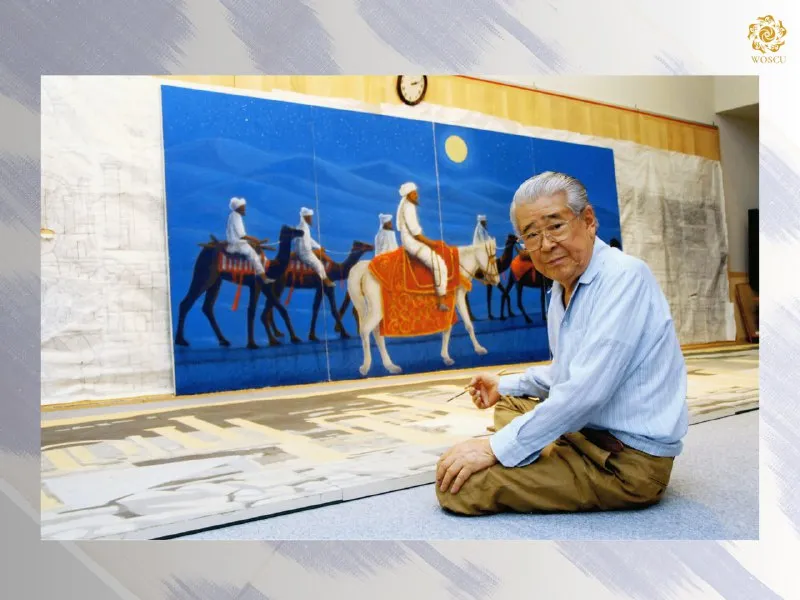
Hirayama was born in the village of Setoda (Hiroshima Prefecture). At the age of 15 he was in the city of Hiroshima, where on August 6, 1945, he survived atomic bombing.
After the war, he enrolled at the Tokyo School of Fine Arts (now the Tokyo University of Fine Arts), where he studied to become a painter. In 1952, Hirayama finished the school and remained there to teach. The turning point of his life was 1959. At the time, Hirayama was suffering from leukemia, and doctors basically gave him the death sentence.
He paints a picture of the origins of the Buddhist teachings, “The Origins of Buddhism”, based on the journey of monk Xuanzang, thinking that it may be the last painting in his life. Hirayama was a man of deep faith, that is why his other painting depicting atomic bombing of Hiroshima, stored in the Hiroshima Prefectural Museum of Art, shows the figure of Buddha in the upper right corner of the canvas, as if soaring over a fire that engulfed the city.
You can learn more about the topic in the book-album "Cultural legacy of Central Asia in Japanese Museums" (volume XX) in the series "Cultural Legacy of Uzbekistan in the World Collections".
The general sponsor of the project is the oilfield services company Eriell-Group.