
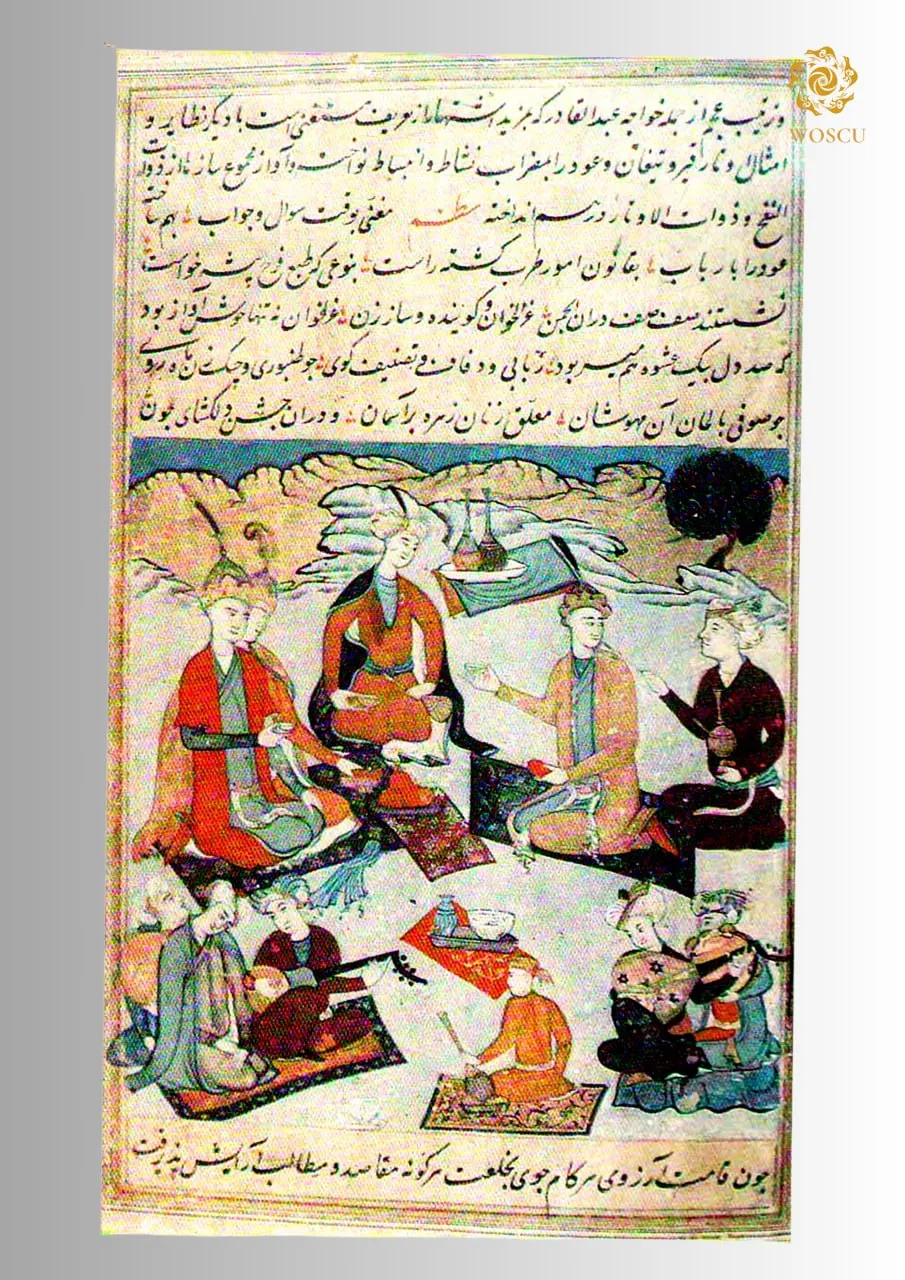
Once Samarkand was established as the capital of the country, it became a major center of musical life. Amir Temur spent a great deal of effort making the city a gorgeous, breathtaking spectacle. From his campaigns he brought home not only skilled craftsmen, architects and builders, but also famous musicians, dancers and singers, who were trained in the arts of different countries and peoples.
Various ethnic traditions interact in Samarkand, fusing together to form the musical culture of the city. There one could hear the music of different peoples (from non-Muslim countries as well) at numerous festive events, weddings (tui or toy), councils (qurultoi) and social and intellectual gatherings (majlis) arranged by Amir Temur. There are reasons to believe that this was Temur’s official cultural policy.
The flourishing of musical life was promoted by the stability of the socio-political and economic standing of Samarkand, and the “imperial style” of Amir Temur‘s rule, such as his passion for grandiose mass festivities with music, his personal intervention in the development of certain areas of musical art, and his patronage over them (military music, maqamat, etc.).
You can learn more about the topic in the book-album "The Musical Legacy of Uzbekistan in Collections of the Russian Federation" (Volume VI) from the series "Cultural legacy of Uzbekistan in the world collections".
The general sponsor of the project is the oilfield services company Eriell-Group.