Until 1950, it was named the Institute for the Study of Oriental Manuscripts. Subsequently, with the development of new areas and the expansion of research scale, it was renamed the Institute of Oriental Studies. In 1957, the Institute was named after the great medieval scholar and encyclopaedist Abu Rayhan al-Biruni (973 – 1050).
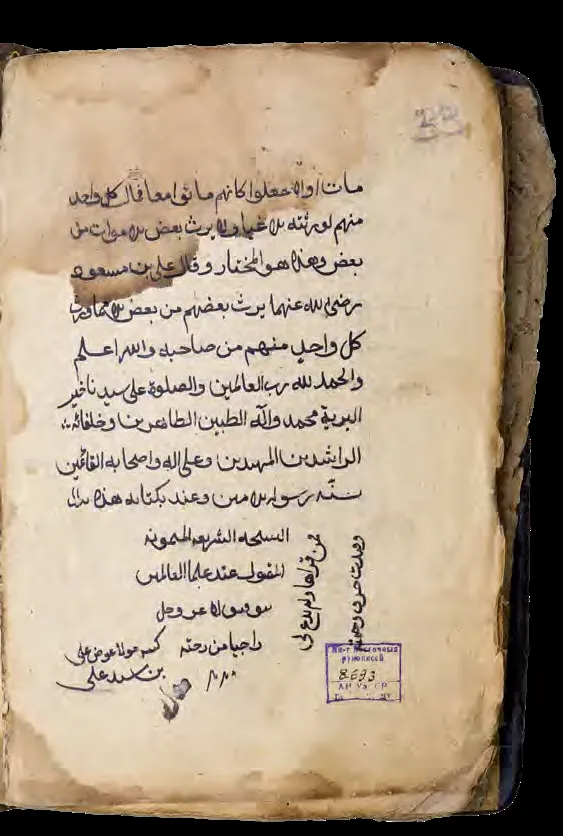
The collection of manuscripts on mathematics includes 213 copies, among which 186 are copies of arithmetic and algebraic treatises (91 works), and 27 are works on geometry (19 writings). The earliest of the mathematical treatises is “Risala fi аl-arithmatiqi” (Treatise on Arithmetic) in Arabic by famous mathematician and astronomer Abu аl-Wafa Muhammad al-Buzjani (940 – 998) represented in rare copy dated to 1881. Works by lawyer and mathematician Siraj al-din Abu Tahir Muhammad al- Sijavandi (12th century) were quite popular i n Central Asia. Among the multiple copies in the Institute’s collection, there are three works on algebra and arithmetic, and “Al-Fara’iz al-Sirajiya” (Inheritance Law by Siraj al-din) is the most widely spread practical treatise on Muslim inheritance law.
The earliest of the eight available copies dates from 1475 – 1476 Scientific schools such as the Maragin School headed by Nasir al-din al-Tusi (1201 – 1274) and the Mirza Ulugbek Samarkand Astronomical School left their mark in the science of the medieval East. The Maragin School is represented in the collection by the arithmetical and algebraic treatises of Nasir al-din al-Tusi, his disciple, mathematician and lawyer Imad al-din ‘Abd Allah al Haddam (1245 – 1325), and Nizam al-din al-Hasan al Naysaburi (13th – 14th centuries), who was a commentator of several works by Nasir al-din al-Tusi. “Al-risala al-shamsiya fi аl-hisab” (The Solar Treatise on Arithmetic) was especially wide-spread as evidenced by the large number of copies in various book depositaries worldwide. In particular, eleven copies are kept in the al-Biruni Institute and the earliest of them dates from 1552.
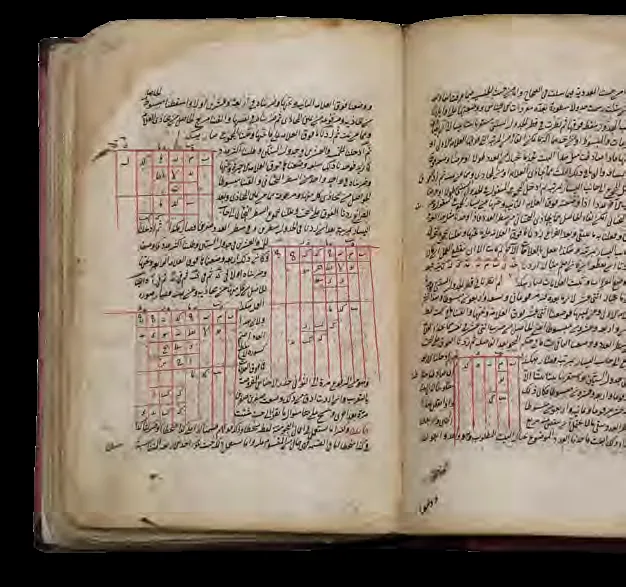
The renowned scientist-encyclopeadist Sa’d al-din Mas’ud ibn ‘Umar al-Taftazani (1322 – 1390) wrote a commentary on the “Solar Treatise” in 1389. There are three copies of the 16th – 18th centuries of this commentary. Works by representatives of the Ulugbek Samarkand School are “Talkhis al- miftah” (Abridged ”The Key to [Arithmetic]”) by Ghiyas al-din Jamshid al-Kashi (d. 1436) in the copy of 1693, and “Risala dar ‘ilm-i hisab” (The Treatise of Arithmetic) by ‘Ala’ al-din ‘Ali ibn Muhammad Qushchi (1402 – 1474) in six copies. One of the copies transcribed in 1510 features calculation tables. There are three unique copies, including “Jadwal-i sittin” (Sexagesimal Numeration System) by Hasan ibn Husain-shah al-Simnani in a manuscript dated to the 15th century; “ Risala-i Sadiqiya dar hisab” (Sadiq’s Treatise on Arithmetic) by Muhammad Sadiq al-lsfahani (14th – 15th centuries); and an untitled treatise on arithmetic by Muhammad ibn ‘Ali al- Kubawi of the 16th century; plus two autographs on arithmetic by lawyer Muhammad Amin al-Muminabadi al-Bukhari written in 1550. Authors of most of the works on geometry are unknown (15 out of 19 works).
The rest are copies of works in Arabic by Nasir al-din Tusi (Inventory No. 4854); Shams al-din Samarqandi (13th century), a scholar from the Maragin observatory, the abovementioned Sa’d al-din Taftazani and a certain Mawlawi Sadiq in Persian in the manuscripts of the 19th century.
You can learn more about this topic in the book-album “The Collection of the Al-Biruni Institute of Oriental studies, the Academy of Sciences of the Republic of Uzbekistan” (Volume XXIII) from the series "Cultural Legacy of Uzbekistan in the World Collections".
The main sponsor of the project is the oilfield services company Eriell-Group.