
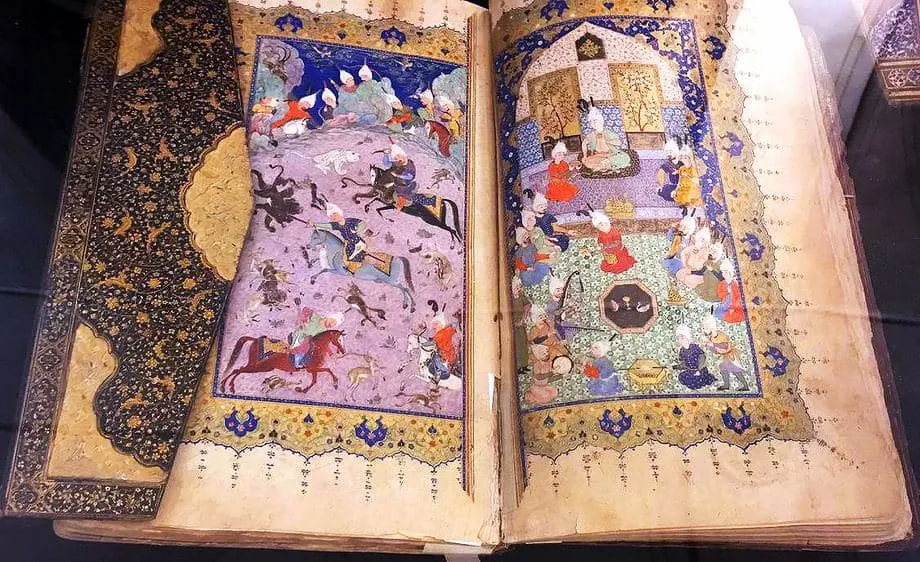
The project 100 Outstanding Manuscripts from Uzbekistan by the World Society for the Study, Preservation and Popularization of the Cultural Legacy of Uzbekistan continues its efforts to return unique handwritten masterpieces made on the Uzbek land as facsimiles.
At the last meeting, held in an online format with the participation of the Chairman of the World Society Firdavs Abdukhalikov, the head of the publishing house of the Oxford University's Bodleian Library Mr. Samuel Fanus, representatives of Mueller & Schindler Charlotte Kramer and Alexander Wilhelm and specialists from the project Cultural Legacy of Uzbekistan in World Collections, supported by the Embassy of the Republic of Uzbekistan in the UK, discussed the possibility of creating facsimiles of famous Hamsa by Alisher Navoi.
The British side, represented by Samuel Fanus, expressed their readiness to work together to create unique facsimile copies of this work.
"Currently, each of the manuscripts exists in a single copy, is kept under seven seals in museum or library collections and therefore is practically inaccessible to either researchers or a wide range of enthusiastic admirers of the art of handwritten books," said the author and manager of the project Firdavs Abdukhalikov. "The facsimiles would make these unique cultural monuments widely accessible, because making facsimiles of unique rarities is a long-standing and well-proven practice. We are happy to have a new opportunity to return one more magnificent cultural monument to Uzbekistan."
The five poems that make up Hamsa are a 15th-century literary monument. Originally, the work consisted of 690 pages and was a single manuscript. However, later, it was divided. 4 parts of the manuscript are now kept in the Bodleian Library in Oxford, and the fifth part is in the John Rylands Library in Manchester.
"It is a great honor for us to be part of a unique project implemented by Uzbekistan," comments Charlotte Kramer, owner of the Austrian publishing house Mueller & Schindler. "The unique research practice of the World Society for the Search, Study and Recreation of exact copies of ancient and medieval manuscripts deserves high respect and is unprecedented in its goals and scope. We hope that these manuscripts will become a worthy gift to all researchers in the world interested in studying the richest legacy of Uzbekistan."
It should be noted that the created copies of miniatures are transferred to educational and training institutions in Uzbekistan and across the world free of charge.