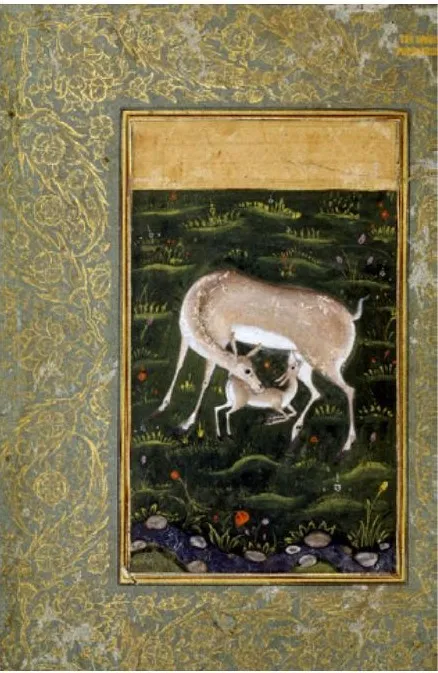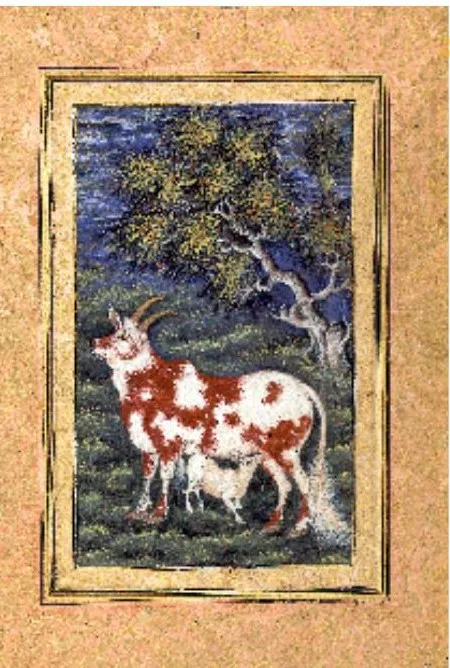
Both miniatures, unlike the reinterpreted Bukhara or Kabul originals, were already written in India, and could well have been specially ordered for the specific purpose of encrypting a message that the recipient had no difficulty in deciphering, appreciating the wit of the customer and the skill of the artists.
Encryption could also be caused by a desire to deceive those for whom this message was not intended. Such a customer could well be Hamida-banu, who not only had her own book workshop at her disposal, but was also famous for her artistic and literary taste. Knowing that her son would be more influenced by the pictorial message, she could well have ordered this visual charade.
A paired two-page composition depicting a doe and a cow feeding their cubs could have had a multi-layered interpretation. The doe could not only be a reminiscence of a constant character in Persian poetry, but first of all, an allegory of an Iranian mother, in contrast to the Indian wet nurse in the form of a cow, an animal revered in India as sacred. Thus, Hamida herself could be represented in the image of a sacred cow -banu, symbolizing the idea of motherhood and unconditional love.
You can learn more about the topic in the book-album "Central Asian Heritage in the Collections Of Cambridge University" (Volume XXVIII) from the series “Cultural Legacy of Uzbekistan in the World Collections”.
The main sponsor of the project is the oilfield services company Eriell-Group.