
Husayn Bayqara, the last great ruler of the Timurid Empire, one of well-known patrons and poets in the 15th century played an important role in achieving a brilliant level of Turkish culture by absorbing Chinese and Indian influences.
He turned his palace in Herat into a living scientific center, protected the leading thinkers and artists of his era and gained their favour. Poet Kâmî, famous miniaturist Behzad, grandfather and grandson historians Mirkhwand and Khwandmir, Hilali, Hatifi, Dawlat-Shah, author of Tadhkirat al-Shu‘ara, calligrapher Sultan Ali of Mashhad, also a childhood friend of Husayn Bayqara, ‘Alishir Nawa’i, were the scientists and artists who gave the court in Herat the feature of the academy of sciences.
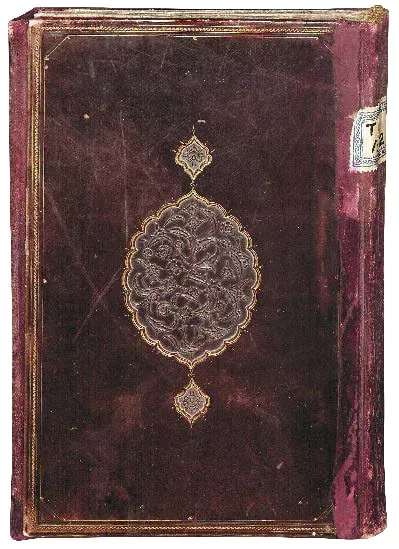
Husayn Bayqara, who also wrote Turkic and Persian poems under the pseudonym Husayni, published his poems in Turkic under the title Diwan-ı Sultan Husayn Mirza Bayqara. A part of his poems was also published under the title Selections from Husayn Bayqara’s Diwan. This work, with inventory number 1926, is one of the diwans where Sultan Husayn Bayqara collected his poems written in Chagatay Turkic. It is one of the most beautiful examples that have survived among Bayqara’s Diwans, many copies of which were prepared from the 15th century to the 19th century.
The collection covers thirty-eight poems by Husayn Bayqara. The text is written on blue, green, yellow, orange, and white muraqqas in the nastaliq script. The calligraphy as Qati‘. The manuscript lacks a colophon and date, but judging by the style of calligraphy and decorative design, as well as the high level of execution, it was produced in Herat in the late 15th century. The manuscript underwent restoration, during which some of the final pages were lost. The restoration was carried out in Ottoman Palace workshops in the 16th century. For this reason, it cannot be known for sure by whom and on what date the diwan, which has an incomplete ending, was copied. The opinion widely accepted by most researchers is that the Qati‘s of the text written with the line of the famous calligrapher of the period Sultan-‘Ali Mashhadi, was made by ‘Abdallah Qati‘, the famous Qati‘ master of the 15th century.
The Qati‘ technique is the art of carving paper or leather, and sometimes a combination of these two techniques. It was extensively used in the decoration of books during the Timurid Period.
_FgAd3D9_1.webp)
The work with the foundation seals of Sultan Mahmud I. and inspector Darwish Mustafa was transferred to the Museum from the Hagia Sophia Library on April 13, 1914.