
In Islamic ornamental decoration, there were two types of medallions – oval turunj, which was mentioned above, and round – shams, shamse or shamsa. In Arabic, this word means the Sun, which immediately clarifi es the symbolic meaning of the motif with rays radiating from it.
_vANBDBJ_1.webp)
In the structure of the book, shams adorned the flyleaf – the first page, pasted on one side to the inner cover of the cover. In fact, it is an ex-libris, a headpiece indicating the title and name of the book’s customer, a person of noble origin. In this regard, Arabic calligraphy was its indispensable accompaniment.
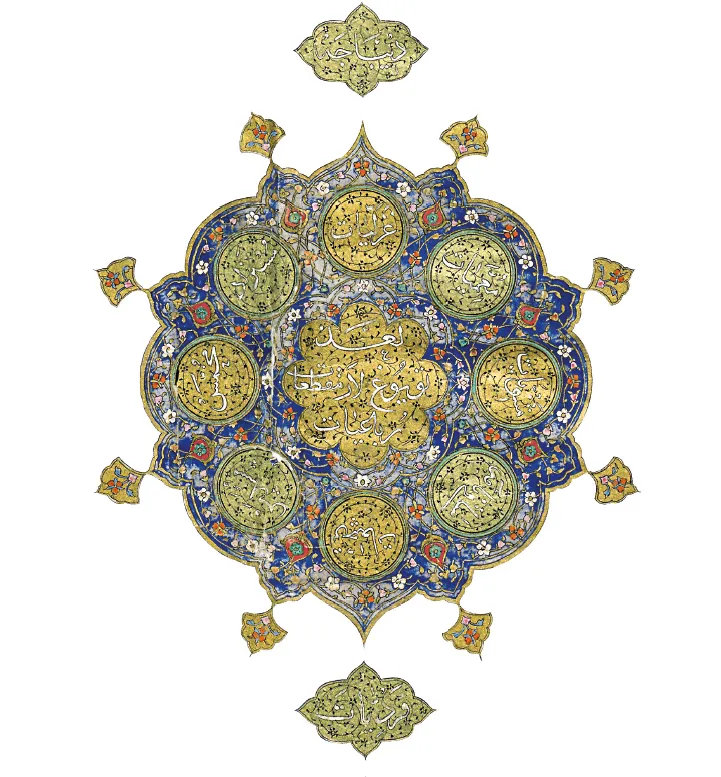
In turn, Shams-Sun appealed to many other sublime concepts. This is not only the personifi cation of the center of the universe, but – more broadly – the expression of the idea of God as the center of the universe, the revealed divine presence and perfect beauty (jamal).
Shams appeared in endless artistic variations. More often it is a scalloped circle with the thinnest arrow-rays diverging from it – tig (the term sharafa is also used). The inner space of the medallion was painted with the ubiquitous vegetative patterns of islimi, in combination with palmettes or with geometric motifs. Often, like turunj, it is fl anked from above and below by kitab (cartouche) and kubba (dome) motifs forming a chain of additional “high” meanings.