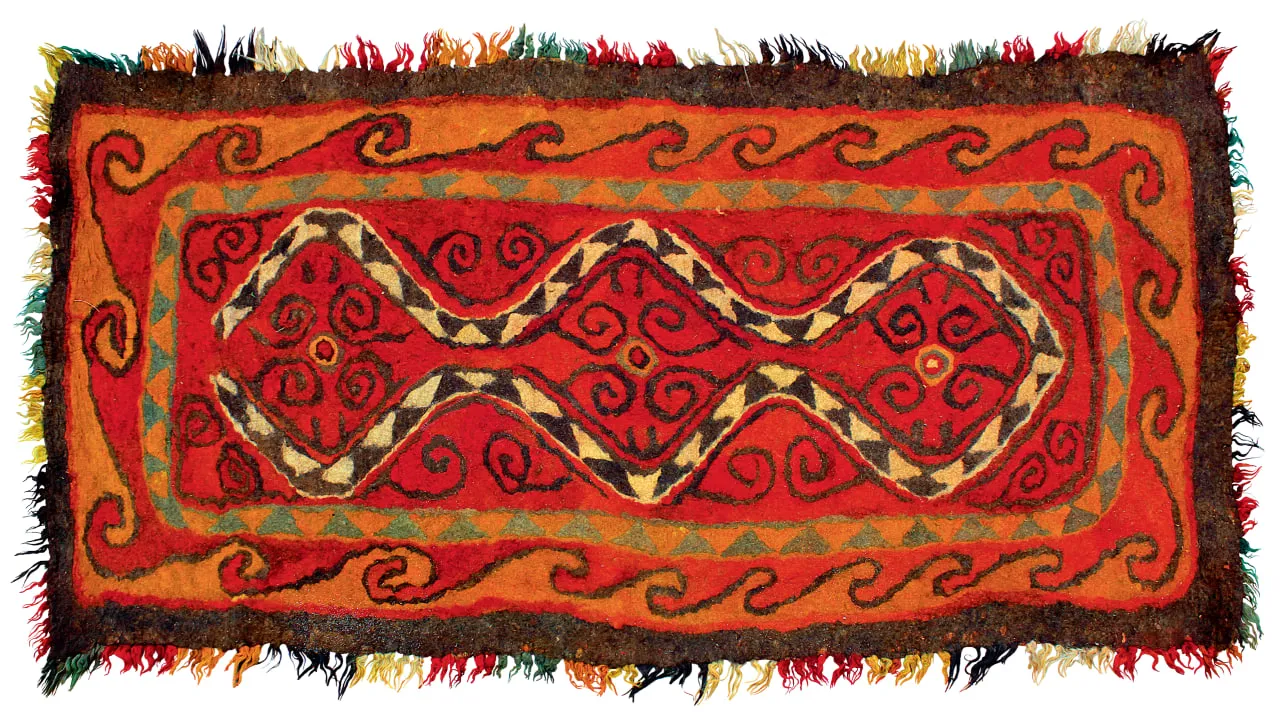
Water is the main source of life for all peoples and a popular ornamental motif. But how to depict water, especially flowing one? To do this, Uzbek craftswomen used several techniques.
The first one is the simplest monochrome stripes separating the border of the carpet from the middle field. They were called literally su (water). If the middle field is the world that the female masters imagined, and the border is its main boundary, protection, then the inconspicuous strips of su seemed to saturate this picture of the world with life, since water has always been associated with the concept of “life”.
The original interpretation of the motif of water is found in the kilims of the Kashkadarya Arabs – stepped combs arranged one after another in narrow strips into which the composition is divided.
_Og8eaWQ_1.webp)
The classic method of depicting flowing water among many peoples was the meander – the motif of an infinite wave.
Its name derives from the river Meander (Menderes) in Asia Minor, which had a very winding riverbed. This pattern is believed to bear the idea of eternal movement, the endless flow of life. In ancient times, this river even became a reason for philosophizing. So, Seneca noted that “the Meander River is a subject of exercises and games for all poets; it winds in frequent bends, comes close to its own channel, and turns away again, just short of merging with itself.”
The meander could have a smooth and geometrized (a line broken at right angles) shape, depending on the material of the object where it is depicted. A smooth meander can be found in the decor of felt carpets and embroidery, geometrized – in woven ones. As a rule, meander shoots were placed in the borders of carpets. Judging by the names under which meander motifs are currently known, their meaning has long been forgotten. Most often, the meander is known as gajak (curl), kelin-hoshi (bride’s eyebrows) and kishik-burun (crooked nose).
_9iQ9MOW_1.webp)
Another symbol of water, a kind of truncated version of the meander, is an S-shaped motif. However, its “aquatic” meaning is also forgotten.
Craftswomen call it tuya-buin – “camel’s neck”, or simply: г-gul, by analogy with the capital letter of the Cyrillic alphabet. In compositions it was used as an additional motif.