
Turkan Khatun was one of the influential women of the Khwarazmshah dynasty founded by Anushtegin. She was the wife of Alauddin Takash and the mother of Alauddin Muhammad Khwarazmshah (reigned 1200–1220)...
Turkan Khatun held a high position during the reign of the Khwarazmshahs. During her reign, the politics of the court were primarily conducted by the queen. Since the Malika belonged to the Kipchak tribe, almost all high-ranking positions were held by the Kipchaks. This caused other emirs and commanders to turn away from the sultan. Even during the Mongol invasion, the defense of every city was entrusted to local leaders under his direction. This ensured the final victory of the Mongols. In 1221, after the capture of Urgench by the Mongols, Turkan Khatun was taken prisoner and taken to Mongolia.
Many historians, including Rashiduddin Fazlullah, provide valuable information about this event. The miniature depicts the princess Turkan Khatun, who once attempted to dominate the entire country, being enslaved and taken to the capital of Genghis Khan. Ahead, one of the women from the sultan's household was walking with a child in her arms. Behind him, in a white robe, walked Turkan Khatun. The last of the Mongol warriors on horseback escorted them.
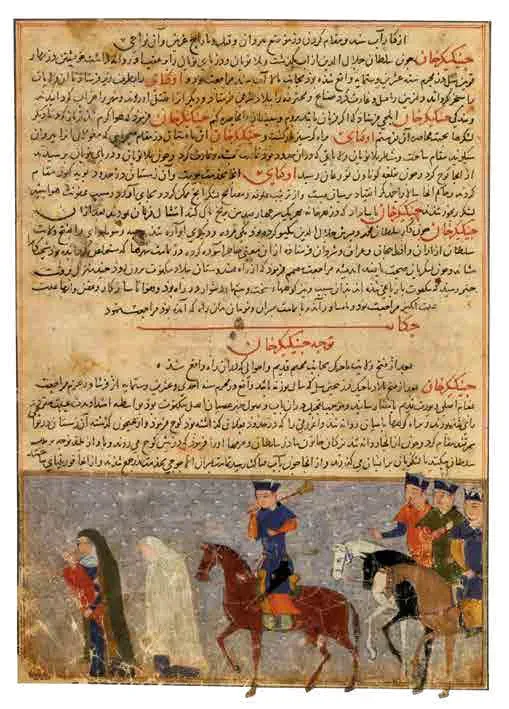
Married to Takash as a result of a political alliance with the Kipchaks, Turkan Khatun was the daughter of the Kipchak Khan Janki from the Bayaut clan, who brought many Kipchak nobles to Khwarazm and became their powerful patron. This union strengthened Khorezm's ties with the peoples of the steppe and strengthened its influence among the nomads. On August 3, 1200, in the presence of the Gurganj nobility and the court, his son Alauddin Muhammad ascended the throne of the Khwarazmshahs. Turkan Khatun, whose status was strengthened in the palace, received the title "Khudovandi Jahon" — "Queen of the World".
These titles and statuses indicate her desire to be not only a matriarchal personality but also a patron of Islamic and Sufi traditions. She was indeed a shining example of female leadership in a patriarchal Islamic society. Turkan Khatun had her own palace, divan, ministers, seal, and political influence, which was recognized even by sultans. The princess actively participated in the appointment of high-ranking officials and directed the activities of the main structures of state administration. His authority was so high that no decree of the state would take effect without his signature.
But... His excessive influence over his own son turned into a tragedy: power was divided, decision-making ceased. When the Mongol invasion began in 1219, it was by order of Turkan Khatun that the defense of the cities was entrusted to local rulers. The lack of a unified command and coordination paved the way for a rapid Mongol invasion of Khwarazm. Cities that were once powerful and prosperous, symbols of the dynasty's power and grandeur, were destroyed one by one. In 1220, Turkan Khatun was captured in the Ilol fortress near Gurganj. By order of Genghis Khan, she was brought to Talikan, where she was ordered to weep loudly in public, along with other noblewomen, over the loss of the Khwarazmian state to the Mongols.
_1.webp)
The Turkan Khatun, who was later brought to Karakorum, died there in 1232 or 1233. Despite her tragic fate, Turkan Khatun went down in history as the most powerful woman of her time, a ruler who truly managed power, possessed diplomatic foresight, and exerted influence over the armies, religious, and cultural life.