
The 15th-century green silk robe not only provides an insight into the palace garments of the Timurid era but also contains important scientific information about the textile arts developed in Central Asia during that period.
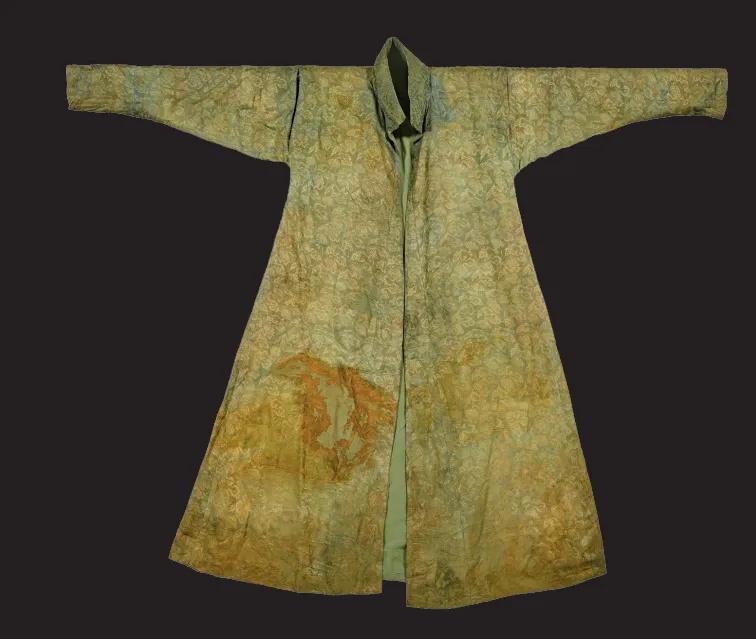
Such a wide and long-sleeved cut was characteristic of ceremonial clothing characteristic of the Timurid era and was considered one of the important elements indicating the social status of the wearer. The dress was made of several pieces of fabric, with an open front, a short collar, and wide sleeves. This structural solution ensured not only the comfort of the garment but also its ceremonial appearance. The robe is woven from silk fabric, and the patterns on it are decorated with a complex ornament called a "cloud ribbon." This pattern creates an impression of movement and light on the fabric surface through its wavy lines.
The "cloud ribbon" motif is one of the most widespread decorative elements in the history of Oriental art. It originated in Chinese art and later spread to Central Asia and Iran. By the Timurid era, this ornament had become an important decorative element of palace art and textile products. Some 15th-century miniatures depict aristocrats dressed in "cloud ribbon" patterns.
The robe also features images of a dragon, a phoenix bird, a lotus, and peony flowers. Each of these images has a specific meaning in Eastern symbolism. The dragon is interpreted as a symbol of power and power, while the phoenix is a symbol of renewal and eternity. Lotus and peony flowers represent meanings related to prosperity, purity, and abundance. For this reason, fabrics decorated with such intricate and symbolic patterns were often used in court settings or in the clothing of the upper class.
The quality of the silk fabric is also one of the important factors determining the cost of the robe. During the Timurid era, Central Asia was known as one of the centers for silk production and textiles. The cities of Samarkand and Herat were particularly famous for their handicraft schools. Fabrics produced in these regions were distinguished by high-quality silk fibers, intricate patterns, and vibrant colors. The luster of the fibers and the smooth movement of the patterns on the robe's fabric lend the fabric a depth as if woven with light.
Today, this priceless piece of clothing is kept in the collection of the Center of Islamic Civilization in Uzbekistan, in the Shohrukh Mirzo sector of the Second Renaissance Department.