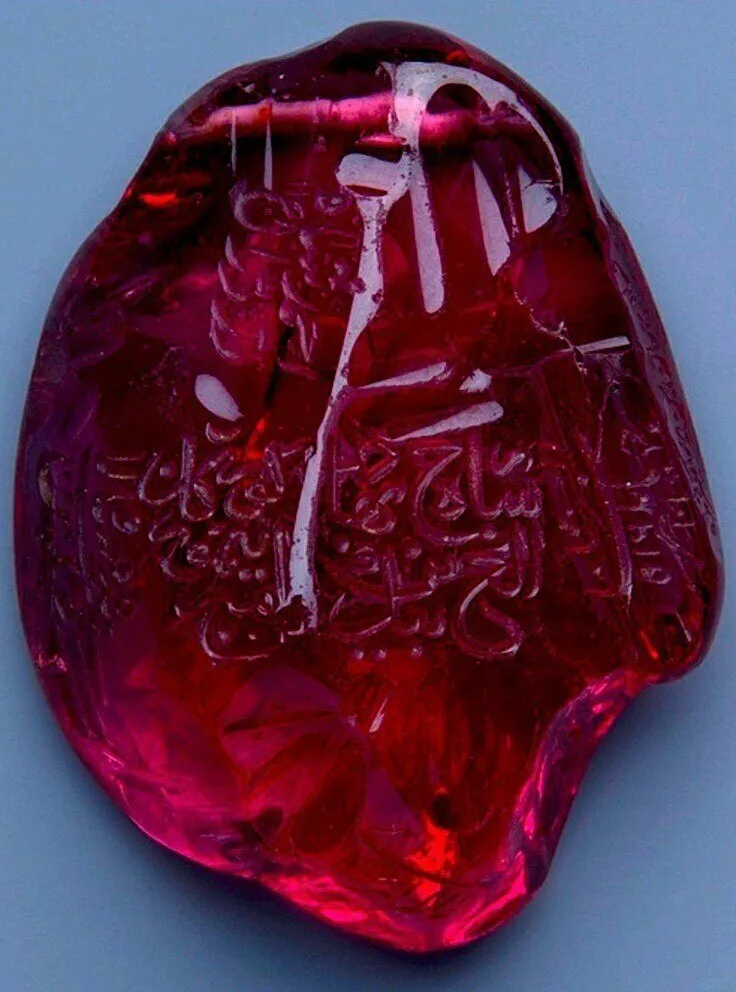
The fate of an exquisitely bright purple stone known as the "ruby of Timur" is amazing.
The precious stone has become a unique historical monument not only of jewelry art, but also of writing.
To begin with, the famous "ruby" is not actually a ruby. This in fact is spinel related to ruby. The stone is one of the largest and most beautiful spinels in history: it weighs 351 carats. The master skillfully combined a central stone with smaller ones. That was how a wonderful necklace appeared - a gift from the management of the East India Company to Queen Victoria of England.
Jewelers in the mid-19th century decided to leave the stones uncut, so as not to lower their values. Until today, no one suspected that the member of the royal family owned the once lost "ruby of Timur". However, historical inscriptions made on the surface of the stone by order of various rulers helped establish the authenticity of that very jewel. Its first famous owner, as you may probably guess, was Timur, the talented commander and leader of the Turco-Mongolian peoples and a fearless warrior. Timur was the Great Emir of the Timurid Empire (14th-early 15th century), better known by the nickname of Tamerlane.
It has been established that Timur obtained the legendary jewel during the military campaign to India, after the capture of the city of Delhi in 1398. Can you imagine that he not just captured the city, but ordered that his troops ruin it and burn it down! In order to avoid the mutiny of Indian prisoners of war, 100 000 soldiers captured by the emir were brutally kill by his order.
But let's return to the story of the ancient “ruby”. Each owner sought to leave a memorable inscription on the surface of the spinel. But the precious thing was in fact not so large: only 4 centimeters long and a little more in width. "How could six rulers find enough place for their inscriptions on it?" you may ask. The answer is simple: every next master made his inscription on top of the previous one, trying to erase the written evidence of the former owners of the treasure.
Among those that left their commemorative inscriptions on the adornment were not only Mughal rulers, but also Persian ones. They are made in a perfectly beautiful scripts. That was how Tamerlane's grandson, the great Ulugbek, made himself famous. The names of Shah Abbas of the Safavid family, as well as Emperor Jahangir, a descendant of the Mughals, are inscribed nearby. There are several other rulers, among whom is the famous Shah Jahan, who ordered the construction of the grandiose Taj Mahal Palace. His fate was sad: his own son put the ruler in prison.
When Delhi went through terrible times again and was captured by the Persian ruler Shah Jahan, this time in the 18th century, the "ruby" with artistic inscriptions was among the trophies. Its next owner was Ranjit Singha. The British authorities suppressed the uprising of the Sikhs and seized their property. The purple stone once again changed the owner. The necklace was gifted to Queen Victoria by the East India Company and was brought to one of the halls of the Buckingham Palace.
It should be noted that most likely the ornate inscriptions on the smooth curves of the stone are inscribed in blood... After all, almost every ruler left after himself traces of fierce wars, deaths and betrayals.
Legends about the ruby of Amir Temur and other oriental adornments can be found in the books from the Cultural Legacy of Uzbekistan in the World Collections series.
The general sponsor of the project "Cultural legacy of Uzbekistan in the world collections" is the oilfield services company Eriell Group.