
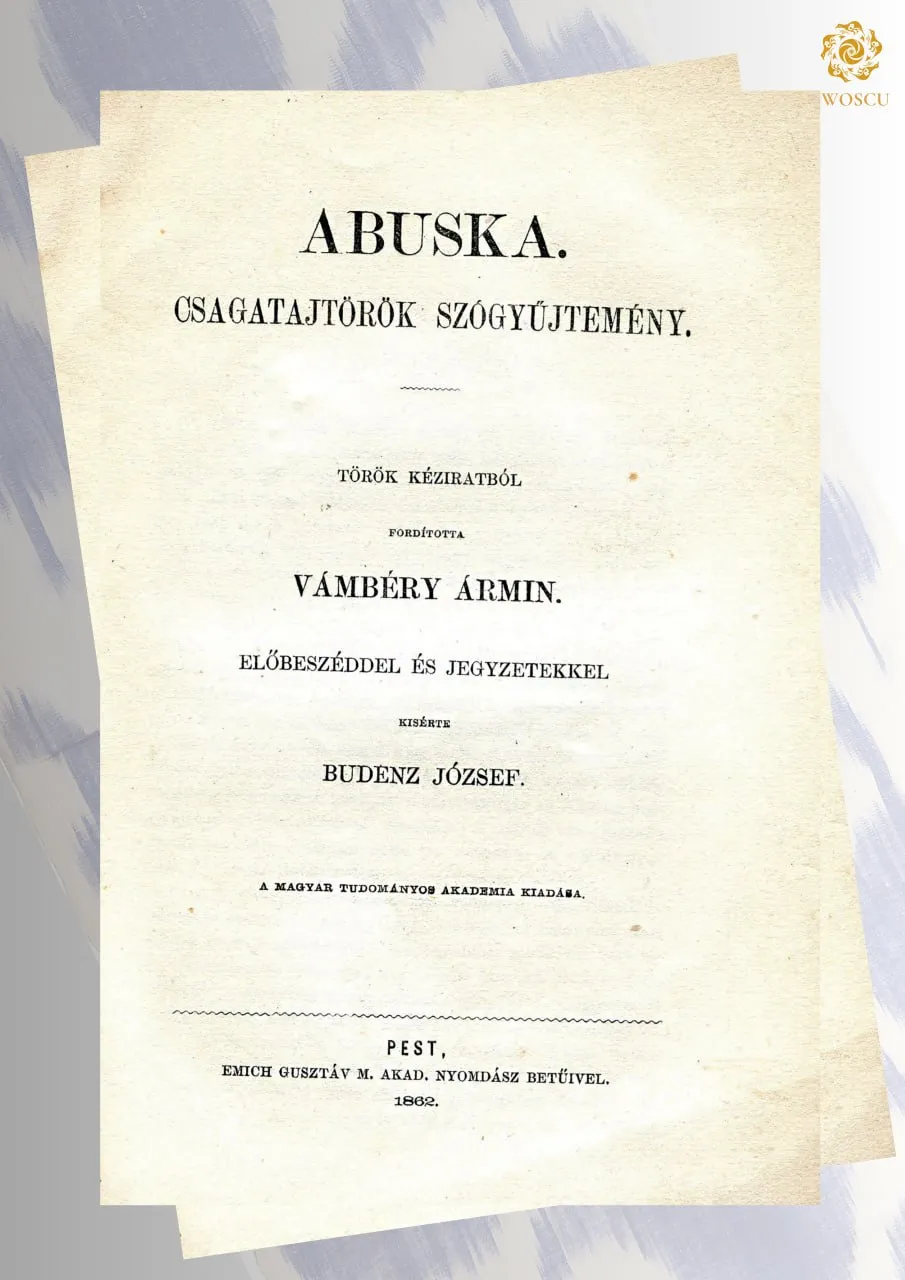
Navāyī’s poetry played an important role in establishing the classical Ottoman imperial literary paradigm. His Dīvān was preserved in several copies in the royal palace library in the early 16th century and his poems were popular outside court circles as well. Many Ottoman poets wrote poetic replies to Navāyī’s poems in Ottoman Turkish but due to the differences between Ottoman and Chahgatay, Ottoman readers had difficulties in fully understanding Navāyī’s texts. Niyāzī’s dictionary was meant to amend the situation.
This lexicographical work is usually referred to as Abušqa luġatï in scholarly literature because the first word in the dictionary is abušqa “husband”. Though the dictionary was published several times in the 19th century Vámbéry was the first scholar to prepare a publication on the topic. His booklet is not an edition in the strict sense of the word as it doesn’t contain the full text of the dictionary, only the headwords are included and their meanings in Hungarian.
Vámbéry had his own copy of this important dictionary (Ms. Török O. 386). His ownership stamp bearing his Ottoman name Reşīd efendi and the date 1274 [1857] and his ownership note written in Arabic characters on fol. 1a suggest he acquired this copy during his stay in Istanbul.
You can learn more about the topic in the book-album "The Cultural Legacy of Uzbekistan in the Collection of the Hungarian Academy of Sciences" (Volume XLII) in the series "The Cultural Legacy of Uzbekistan".
The general sponsor of the project is the oilfield services company Eriell-Group.