
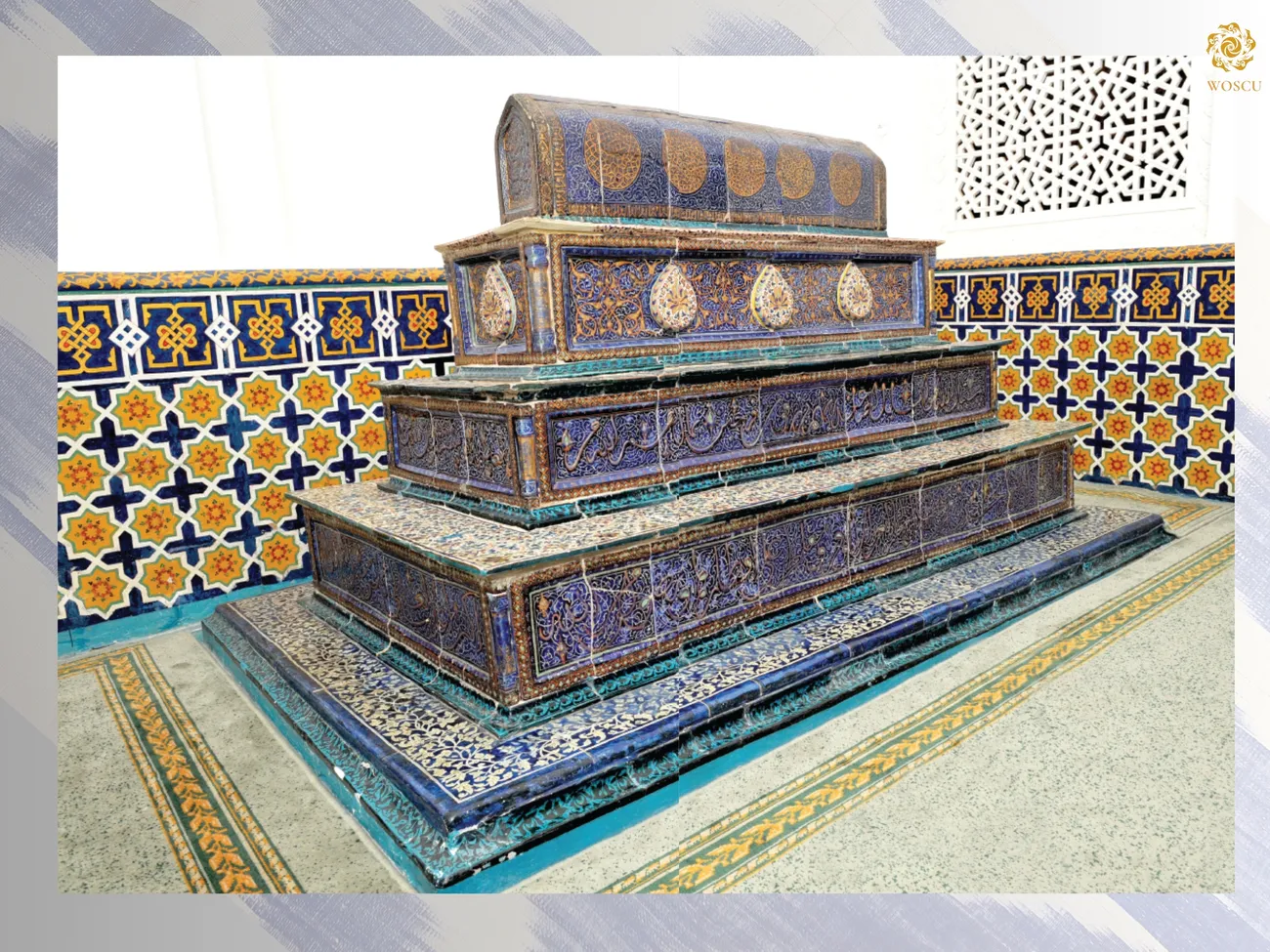
The passage between the structures was separated by the laced lattice consisting of the separate elegant segments. Approximately in the 80s of the 14th century the stepped grave-stone covered with painted majolica tiles was installed above the tomb of Qusam ibn ‘Abbas. Fragments from the Koran were written with gilded characters on the lateral sides of it. The end face of the grave-stone has an epitaph to Qusam ibn ‘Abbas.
Actually the grave-stone has direct analogues in its decoration technique and paleography of inscriptions among similar structures in Khorazm (Khiva, Kuhna Urganch). The text on the gravestone is written in a very individual script style that may be called a model of highly artistic calligraphy. A very high-skilled calligrapher had used the diwani script in which we can see the elements of other scripts (ta‘liq or an ordinary italic scripts of the naskh type).
In some places he was writing almost uninterruptedly, without raising his pen, and connected the letters and words by plastic lines without putting diacritical signs. In such places the inscription resembles one continuous line with very plastic outlines. However, this «line» can hardly yield to reading. Probably for this reason, so far this inscription could not have been read in full by travelers and then researchers who could see it.
You can read more about the inscriptions on the buildings of the memorial ensemble in the book-album “Samarkand. Shakhi-Zinda” series “Architectural epigraphy of Uzbekistan”.