
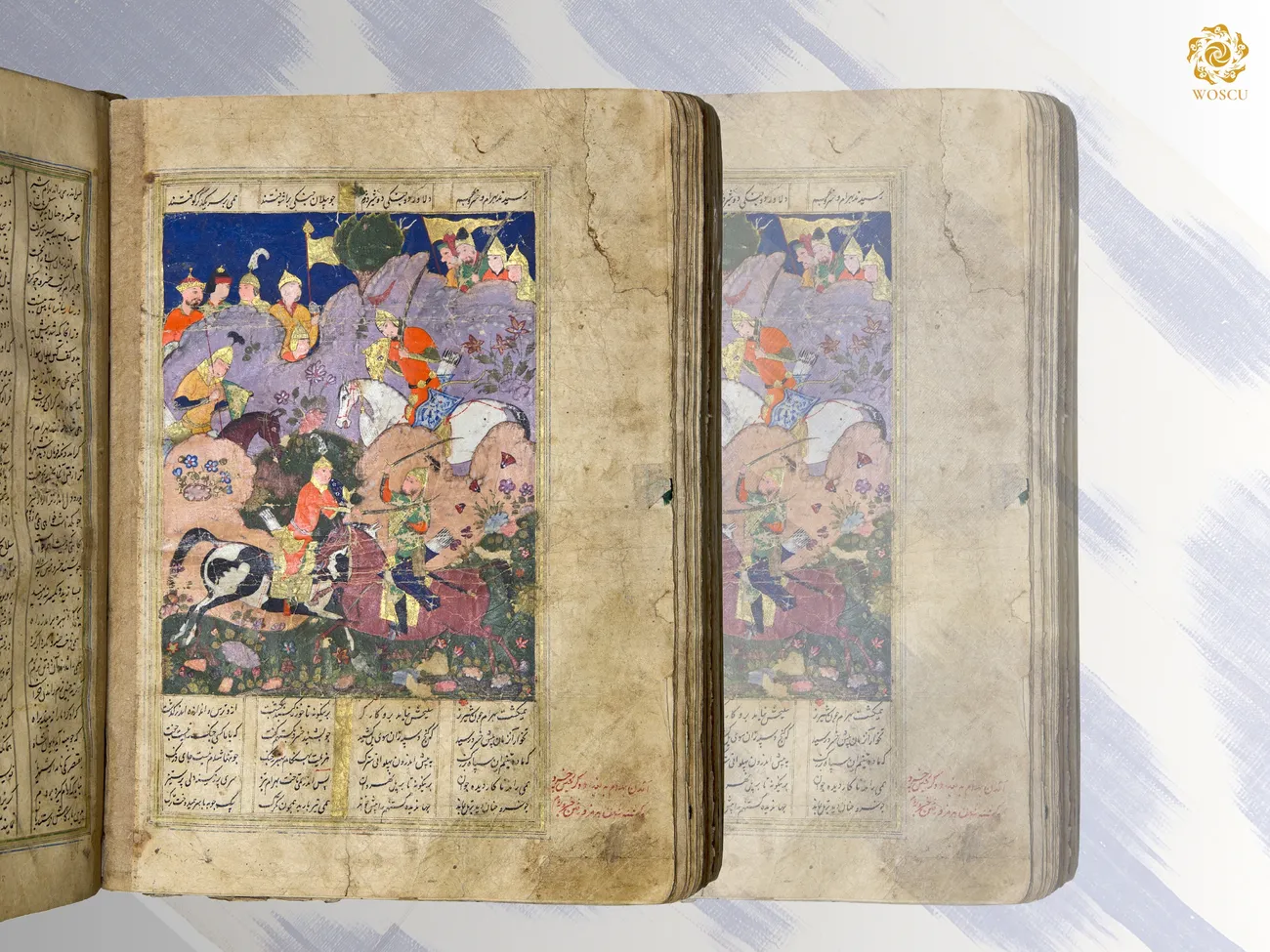
Literary sources and inscriptions on some miniatures have preserved the names of the miniaturists from that time. Among them are Khwaja Gado, Mulla Bihzad, Muhammad Amin, Muhammad Muqim, Avaz Muhammad and Muhammad Salim. Judging by the signed miniatures, they were highly-skilled artists.
In the Institute’s collection there is a manuscript Inventory No. 3463 “Shah-nama” (1074 AH/1664), in which there is a miniature bearing the signature of Muhammad Muqim, modestly calling himself “worthless.” Actually this is just of formula of politeness. Muhammad Muqim was one of leading artists at the court of Abdalaziz II in Bukhara. He was uniquely prolific but at the same time he never forgot about quality. A number of miniatures with his signatures are known and these made it possible to identify his other unsigned works.
The manuscript “Shah-nama” was illustrated largely by two master artists with only a few miniatures produced by a mediocre artist, probably, a pupil. One of these, as mentioned above, was Muhammad Muqim. The name of the other artist has not been determined. Their styles are absolutely different, which is not unusual. The study of Central Asian miniatures of the 17th century provides evidence of cooperation between artists working in different styles within the Bukhara studios. Some followed the canons of the classic Behzad style innovating only in some detail. Others violated these principles developing an expressive “baroque” style typical of the Samarkandian illustrator of “Zafar-nama” 1628. Still others turned to the Indian miniatures of the Baburid court adopting a spatial approach to painting with natural and architectural scenes in distant perspective.
You can learn more about this topic in the book-album “The Collection of the Al-Biruni Institute of Oriental studies, the Academy of Sciences of the Republic of Uzbekistan” (part five, “Miniature and Calligraphy”) (Volume XXV) from the series "The Cultural Legacy of Uzbekistan".
The main sponsor of the project is the oilfield services company Eriell-Group.