
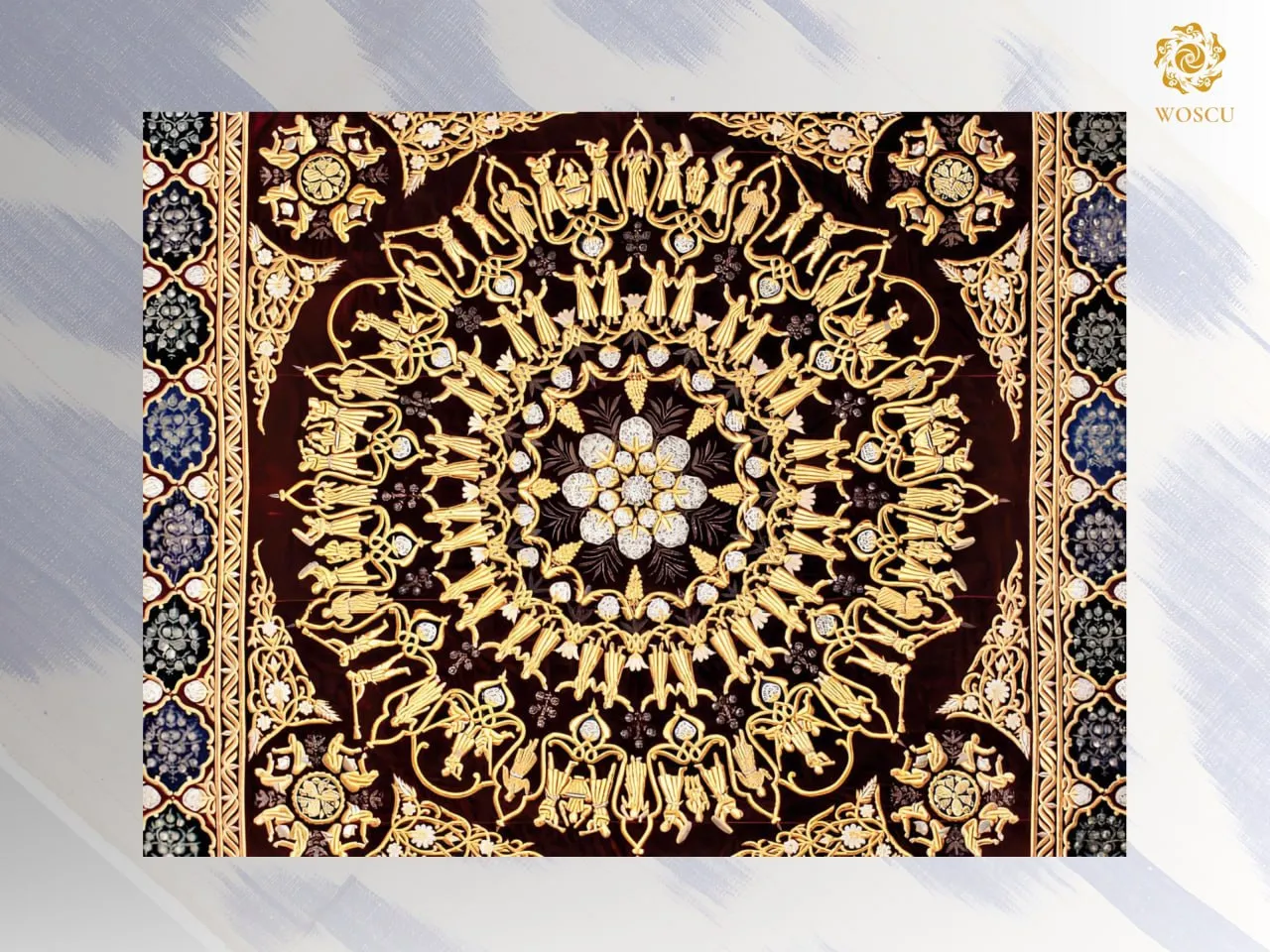
There is every reason to believe that the art of gold stitching flourished at the court of the Sassanids, whose power extended to the cultural and historical areas of Central Asia.
The existence of this type of court art during the reign of Amir Timur is reported by the Spanish envoy Ruy Gonzalez de Clavijo in his diary, describing his journey to Samarkand in 1403-1406. Vasifi mentions the profession of gold embroiderers-zarduzs during the times of Alisher Navoi in Herat in his memoirs. Describing the participants of a literary assembly, he names among them a certain Hasan-zarduz, apparently belonging to the refined society of "the brilliant young men of Herat".
The high level of development of gold embroidery in Samarkand and Herat is also evidenced by later historical sources. Thus, the historian Melikho reported that there was a quarter of gold embroiderers in Samarkand. Gradually, this activity focused exclusively in Bukhara, which became the capital of the Uzbek state of the Shaybanids in the 16th century. Here, gold embroidery attained the status of official court art. In his work "Journey to India," Abdurazzak Samarkandi left information about garments adorned with gold embroidery in Herat in India during the reign of Shahrukh. Documents and monuments from the same period also mention the craft of gold embroiderers and their products.
The well-known Bukharan poet and artist of the 17th century, Fitrat, engaged in the gold embroidery craft and himself embroidered beautiful patterns on fabric. Hundreds of skilled hereditary embroiderers were engaged in the production of rich gold embroidered garments, which were part of the lavish court etiquette of the Bukharan emirs.
During the reign of Emir Alimkhan in Bukhara, there were workshops that fulfilled court orders. Some of them were located directly on the territory of the Ark. Here, they embroidered men's and women's robes, women's caps and scarves, shoes, belts, horse blankets, and much more. Almost all of the gold embroidery production was consumed by the emir's court, and only a minor part was sold on the market.
You can learn more about the topic in the book-album "The Collection of the State Museum of Applied Art and Handicraft’s History of Uzbekistan" (XXXIX volume) from the series "The Cultural Legacy of Uzbekistan".
The main sponsor of the project is the oilfield services company Eriell-Group.