
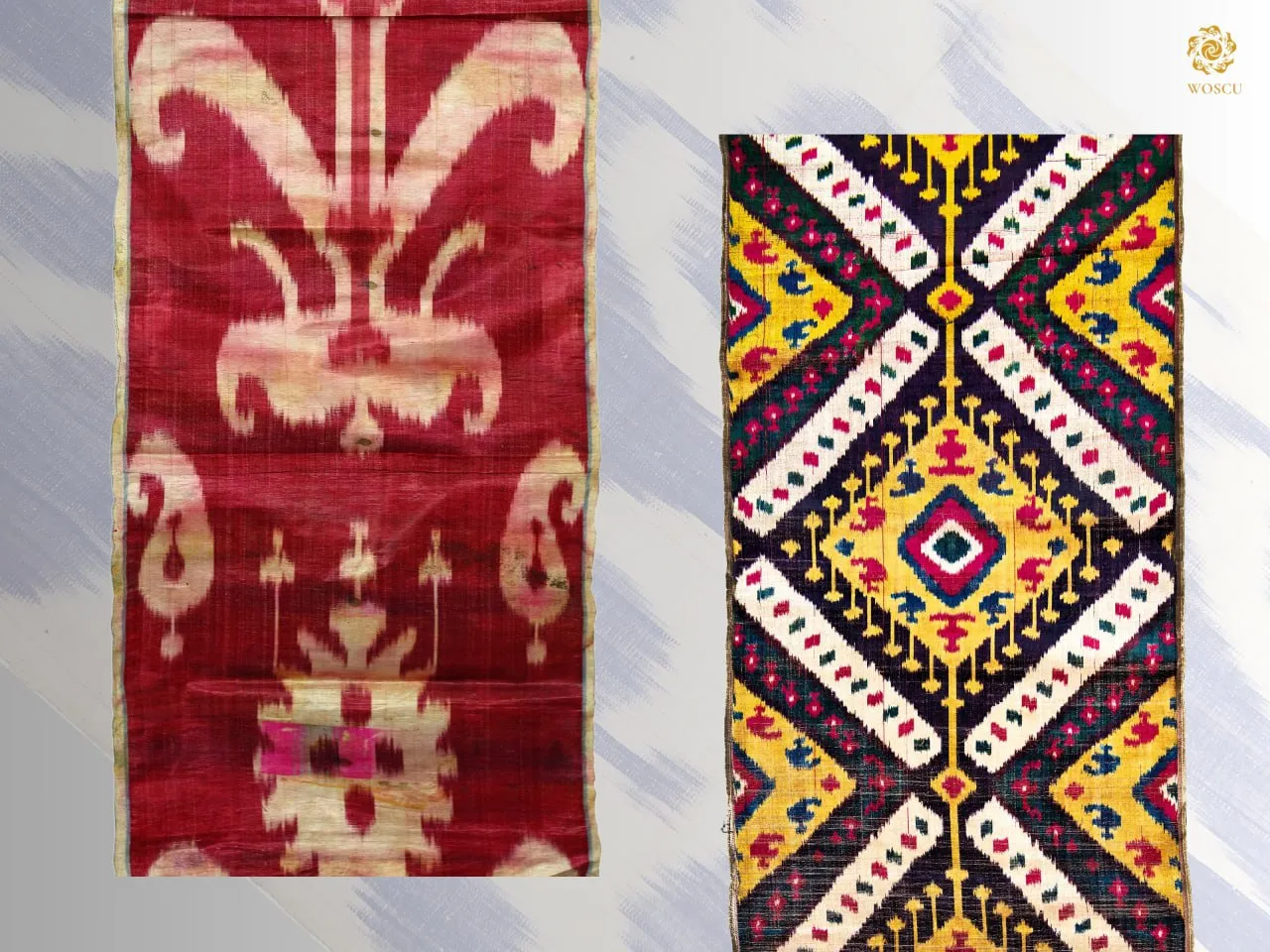
They got their name (abr) because of the complicated and painstaking production method known as abrbandi. This method consisted of binding individual sections of threads and then dyeing them in stages according to the pattern and colour. As a result, fabrics with colourful patterns were made that had blurry contours. In the West, fabrics created using a similar method of dyeing threads are known as ikat.
According to the composition of the material, the ikat fabrics are divided into two groups – silk, in which silk threads are used for both the warp and the weft, and adras fabrics, in which the base was made of silk, and the weft from cotton. The thickness of the cotton weft thread is several times larger than the silk warp thread, so that the surface of the adras acquired a specific ribbed effect.
The ornamentation of ikat fabrics is diverse: images of household items and plant, zoomorphic or geometric motifs. Multicoloured patterns, including all colours of the solar spectrum, were called tirikamon – rainbow, bakhor – spring, chaman – blooming. From the ikat adras to the beginning of the 20th century, in the central regions of present-day Uzbekistan, men’s robes with strict cuts, women’s robes mursak, children’s clothes and dresses were sewn. Adras was used to make pillows, elegant kurpach, quilted blankets and other household items.
The collection of the State Museum of Arts presents unique examples of adras and velvet fabrics (alo-bakhmal) of masters from Bukhara. They are distinguished by an expressive pattern in the form of large medallions and flowers, a rich colour. There are also magnificent examples of Margilan silk fabrics shoi from the first half of the 20th century in the Museum collections. Margilan is still the recognized centre of silk weaving.
During the 19th and the 20th centuries, bekasab striped fabrics were widely used, whose pattern was created by coloured warp threads like in the ikat fabrics.
In the 1920s, the shortage of factory-made fabrics in the country spurred artisanal cotton weaving. However, from the 1930s to the late 1980s, industrial textile enterprises began to operate in Tashkent, Samarkand, and Margilan, which led to the gradual disappearance of artisanal weaving.
Fabrics in the collection of the State Museum of Arts are not only exhibited, but are also being studied. The first work devoted to the artistic textiles of Uzbekistan was the monograph of the ethnographer O. A. Sukhareva. Later the theme of weaving became the subject of research by S. M. Makhkamova and D. A. Fahretdinova.
You can learn more about this topic in the book-album “The Collection of the State Museum of Arts of Uzbekistan” (Volume XIII) from the series “Cultural legacy of Uzbekistan in the world collections”.
The general sponsor of the project is the oilfield services company Eriell-Group.