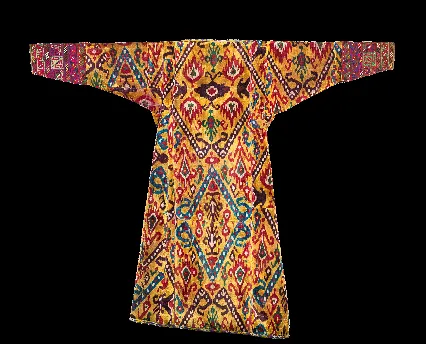
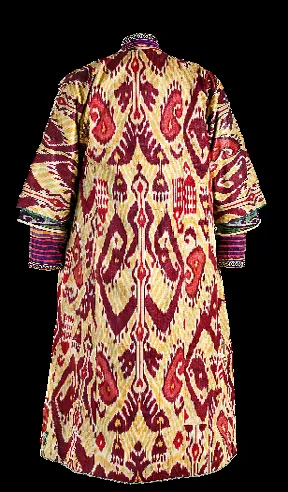
A ram’s horn, snake’s body, or bird’s beak or claw became zoomorphic symbols common throughout the region’s arts. Similarly, depictions of flora – particularly branching trees illustrative of axis mundi (the tree of life) with roots in the underworld, a trunk rising through the terrestrial space, and branches reaching toward heaven–symbolized the cyclical nature of life, death, and rebirth. A fine woman’s munisak illustrates a combination and abstraction of these motifs.
Here, the branched shapes were distilled into long, narrow ram’s horns, the spaces in between filled with a variety of smaller vegetal motifs, resulting in a visually dynamic textile. The fine velvet ikat textile with a rare yellow ground color was made even more sumptuous with the addition of the Turkmen silk-embroidered cuffs.
Similarly drawing upon this motif is an ikat chapan dominated by curving horns, tumars and bodom motifs. The yellow-and-white stripes that emanate from these forms heighten the visual energy of the pattern. You can find these ikat in the Reisbords collection.
You can learn more about the topic in the book-album "The Cultural legacy of Uzbekistan in private collections of the USA and Canada" (volume XXXI) in the series "Cultural Legacy of Uzbekistan in the World Collections".
The main sponsor of the project is the oilfield services company Eriell-Group.