
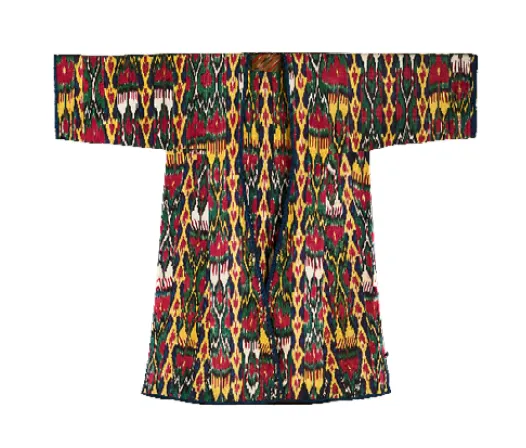
This method known as a resist-dye technique is complex and time-consuming. At the first stage, the drawer (abrbandchi, nishan-zan) marked the outlines of the designed pattern onto silk warps stretched on a frame in separate bundles for convenience. After that, predetermined sections of the bundled threads were bound tightly according to the pattern to prevent the saturation of color when submerged into dye baths. After they were dyed and overdyed repeatedly for every color, the threads were placed on the loom in such a way that, when the work was finished, the motif repeated itself in either a mirrored or stepped configuration. When mirrored, the resulting pattern was vertically symmetrical, as seen in a multicolored ikat chapan (robe) with rows of golden chains, red palmettes and white tumars, the latter often interpreted as combs.
Unlike most chapan robes, this example does not have a lining and was likely intended for warmer weather. Its bright and rich pattern typical of the plain-weave adras fabric is clearly seen on both the outer front and the inner side of the chapan. In total, seven colors were used to dye this intricate ikat. Because each additional dyed color represented a significant amount of labor, multicolored ikats, called haftrang (or “seven colors”) were considered among the most prestigious ikat textiles.
You can learn more about the topic in the book-album "The Cultural legacy of Uzbekistan in private collections of the USA and Canada" (volume XXXI) in the series "Cultural Legacy of Uzbekistan in the World Collections".
The main sponsor of the project is the oilfield services company Eriell-Group.