
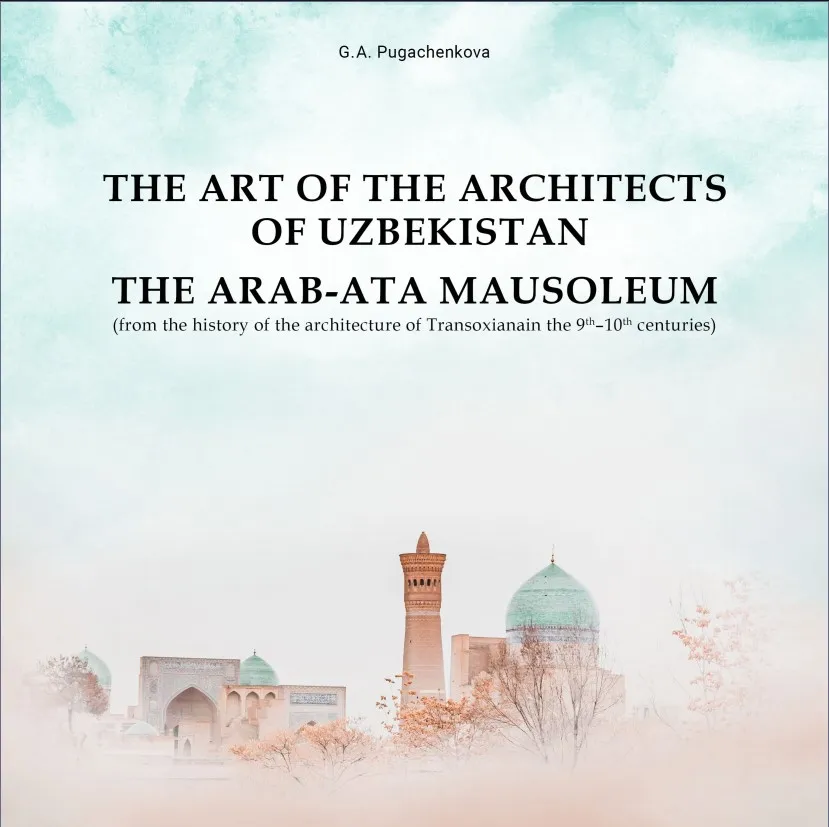
G. А. Pugachenkova THE ART OF THE ARCHITECTS OF UZBEKISTAN THE ARAB-ATA MAUSOLEUM
Description
In early 2019, at one of the meetings of the The Cultural Legacy of Uzbekistan in the World Collections project, a decision was made to publish a new series, The Science and Culture of Uzbekistan in Scholars’ Works, within the framework of this project.
This series includes works of outstanding importance for the history and culture of Uzbekistan and Central Asia. Once published in limited series and overlooked by modern researchers, they are essential rarities.
This series opens with a small, but very significant monograph by academician Galina Anatolyevna Pugachenkova, a well-known researcher in the architecture, archeology and artistic culture of Central Asia and modern eastern countries respected far beyond Uzbekistan.
It is dedicated to the Arab-Ata mausoleum discovered in the late 1950s by a remarkable geographer, Professor N. Leonov. It was studied by G. A. Pugachenkova as part of the Uzbek Art History Expedition (UZISSE) she organized with the support of the Institute of Art Studies, Academy of Sciences of the Republic of Uzbekistan. Architect Pulod Zahidov and archaeologist Bahodir Turgunov took part in the expedition to Arab Ata. Unfortunately, they do not stay any longer among us.
This book is a kind of tribute to the first researchers of the mausoleum. The monograph focuses on and broadly discusses numerous issues related to the history of the architecture of Transoxiana in the early and high Middle Ages, in particular, the origins of centric museums (having all facades equal) in the region, such as Ak-Astana-Baba Preface and Mir Said Bahrom. The earliest known monument of this type, the Arab-Ata mausoleum occupies a special place among them. An inscription in Kufic script is carved on its portal, which is the date of its construction – 360 AH/977 – 978. This is the period of the reign of Amir Mansur I b. Nuh. For the first time it was deciphered by academician M. E. Masson.
"I hope this book, as well as other editions from this series, will be interesting not only to specialists, but also to the general public, since they were written by real researchers for whom daily work in the name and to the glory of their discipline was the call of their souls. «No day without a line» is the motto of their life". -
E.V. Rtveladze
research director of the project,
Academician at the Academy of Sciences
of the Republic of Uzbekistan
G. А. Pugachenkova THE ART OF THE ARCHITECTS OF UZBEKISTAN THE ARAB-ATA MAUSOLEUM
Description
In early 2019, at one of the meetings of the The Cultural Legacy of Uzbekistan in the World Collections project, a decision was made to publish a new series, The Science and Culture of Uzbekistan in Scholars’ Works, within the framework of this project.
This series includes works of outstanding importance for the history and culture of Uzbekistan and Central Asia. Once published in limited series and overlooked by modern researchers, they are essential rarities.
This series opens with a small, but very significant monograph by academician Galina Anatolyevna Pugachenkova, a well-known researcher in the architecture, archeology and artistic culture of Central Asia and modern eastern countries respected far beyond Uzbekistan.
It is dedicated to the Arab-Ata mausoleum discovered in the late 1950s by a remarkable geographer, Professor N. Leonov. It was studied by G. A. Pugachenkova as part of the Uzbek Art History Expedition (UZISSE) she organized with the support of the Institute of Art Studies, Academy of Sciences of the Republic of Uzbekistan. Architect Pulod Zahidov and archaeologist Bahodir Turgunov took part in the expedition to Arab Ata. Unfortunately, they do not stay any longer among us.
This book is a kind of tribute to the first researchers of the mausoleum. The monograph focuses on and broadly discusses numerous issues related to the history of the architecture of Transoxiana in the early and high Middle Ages, in particular, the origins of centric museums (having all facades equal) in the region, such as Ak-Astana-Baba Preface and Mir Said Bahrom. The earliest known monument of this type, the Arab-Ata mausoleum occupies a special place among them. An inscription in Kufic script is carved on its portal, which is the date of its construction – 360 AH/977 – 978. This is the period of the reign of Amir Mansur I b. Nuh. For the first time it was deciphered by academician M. E. Masson.
"I hope this book, as well as other editions from this series, will be interesting not only to specialists, but also to the general public, since they were written by real researchers for whom daily work in the name and to the glory of their discipline was the call of their souls. «No day without a line» is the motto of their life". -
E.V. Rtveladze
research director of the project,
Academician at the Academy of Sciences
of the Republic of Uzbekistan