
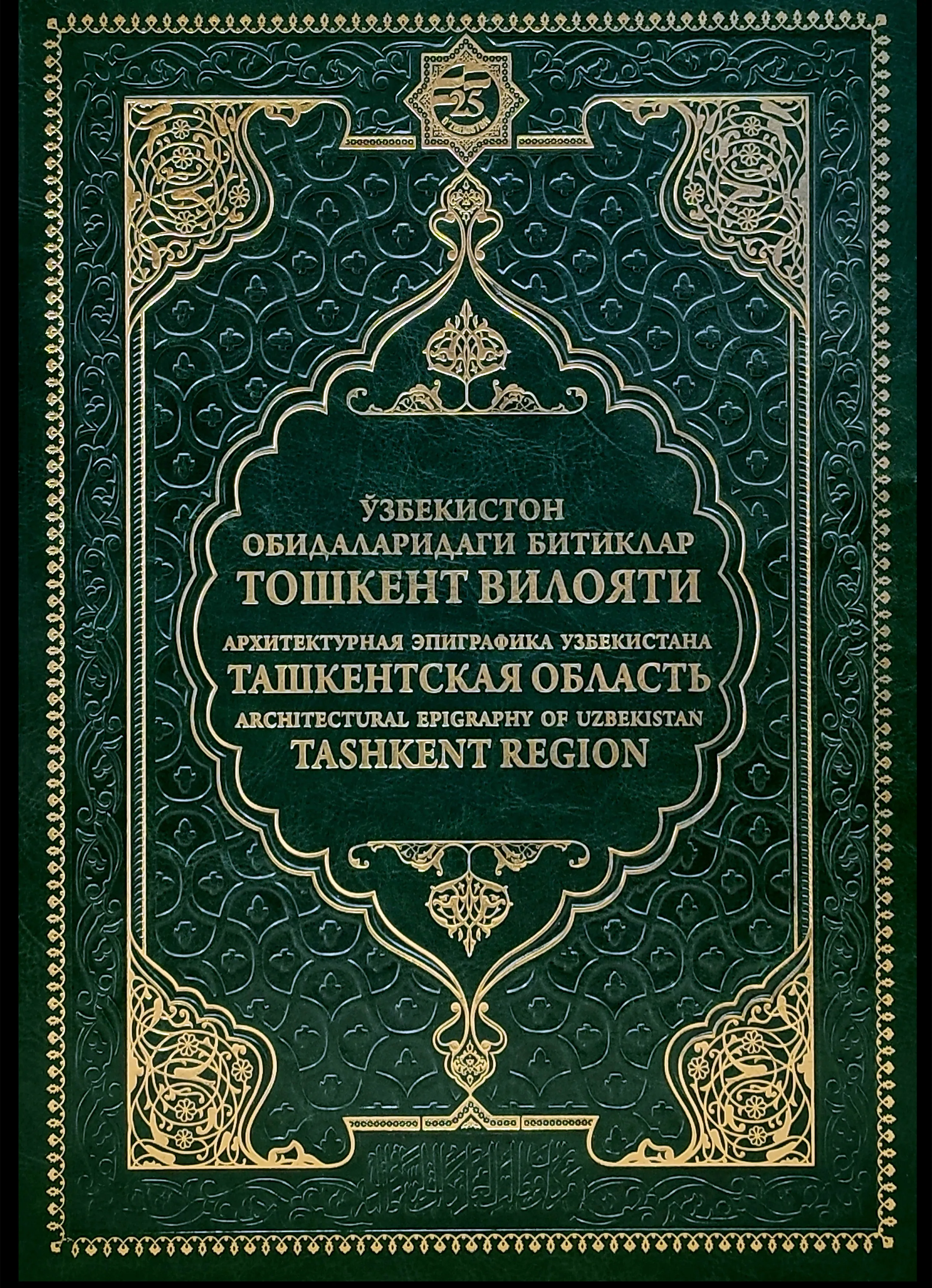
ARCHITECTURAL EPIGRAPHY OF UZBEKISTAN TASHKENT REGION
Description
Tashkent region occupies a vast piedmont plain between the Syr Darya River and the spurs of the Western Tien Shan. After Amir Temur came to power in Transoxiana, the Tashkent oasis became his stronghold for fighting the rulers of Mogulistan. Amir Temur used Tashkent region to move to the city of Turkestan (Yassy), where he lay the foundation of the buildings at the memorial complex of Khoja Ahmad Yassavi.
The time of Amir Temur and the Temurids was the heyday of constructional and architectural activity, as well as crafts and trade, material and spiritual culture. Amir Temur paid great attention to the construction of mausoleums, mosques and khanqahs. Such activity, which was considered pleasing to God (khair), can be traced in the Tashkent oasis as well. Following his order, a huge mausoleum was built at the burial of Sheikh Zainiddin instead of a modest tomb, which has now been restored and thoroughly reconstructed.
The complex is one of significant structures marking the heyday of Central Asian architecture in the 15th century.
ARCHITECTURAL EPIGRAPHY OF UZBEKISTAN TASHKENT REGION
Description
Tashkent region occupies a vast piedmont plain between the Syr Darya River and the spurs of the Western Tien Shan. After Amir Temur came to power in Transoxiana, the Tashkent oasis became his stronghold for fighting the rulers of Mogulistan. Amir Temur used Tashkent region to move to the city of Turkestan (Yassy), where he lay the foundation of the buildings at the memorial complex of Khoja Ahmad Yassavi.
The time of Amir Temur and the Temurids was the heyday of constructional and architectural activity, as well as crafts and trade, material and spiritual culture. Amir Temur paid great attention to the construction of mausoleums, mosques and khanqahs. Such activity, which was considered pleasing to God (khair), can be traced in the Tashkent oasis as well. Following his order, a huge mausoleum was built at the burial of Sheikh Zainiddin instead of a modest tomb, which has now been restored and thoroughly reconstructed.
The complex is one of significant structures marking the heyday of Central Asian architecture in the 15th century.