
A special group of finds from Karatepa is epigraphy. These are inscriptions on vessels, painted with black paint, and graffiti inscriptions scratched on the caves’ walls.
The inscriptions on ceramics were made in Old Indian script, as well as Bactrian script, based on the Greek alphabet, and dated to the golden age of the Buddhist temples of Karatepa.
The fundamental study of the epigraphic finds of Karatepa was carried out by V. V. Vertogradova (1995) and V. A. Livshits (1996).
Most of the Bactrian inscriptions on the ceramics found at Karatepa denote that the vessels belonged to certain persons (Buddhist monks). The other part of the inscriptions was a wish of well-being and didactic. Besides the Bactrian inscriptions, Kharoshthi and Brahmi inscriptions were found in Karatepa. A vessel fragment with an inscription in Brahmi was found in the western part of the courtyard in 1987. V.V.Vertogradova reconstructed the inscription as follows:
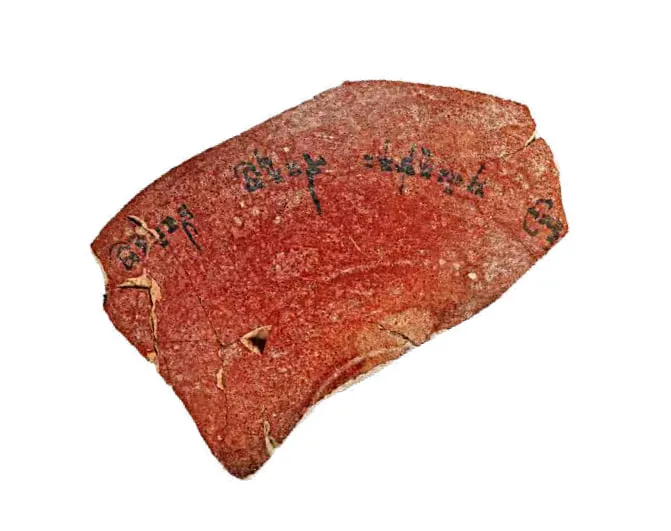
“The Good! OM! This vessel for water of monk Jivananda [private. Do not take!]”.
It should be mentioned that the making of such an inscription had a sacral purport. As V. V. Vertogradova explains, the practice of making a signature on a vessel with an owner’s name in the Indian tradition, in particular, in Karatepa,was of stable structure and consisted of a set of wishes of well-being and protective formulas. A text of this kind was the original confirmation of the monk’s identification and his virtues.