
One of the most outstanding finds on Fayaztepa, discovered in 1968, was the Triada composition depicting the Buddha sitting in meditation under the sacred Bodhi tree (tree of knowledge) and two monks standing on either side of him.
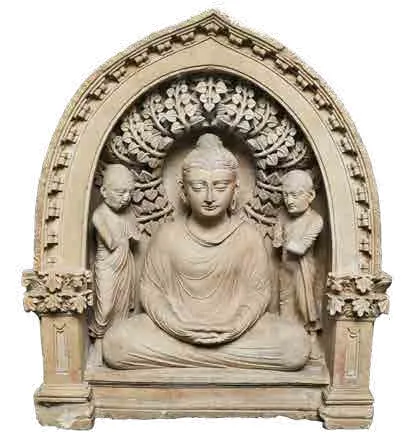
The Buddha wearing a robe (sanghati) is seated in a meditative pose (dhyana mudra) under the sacred Bodhi tree. Flanking him on both sides are figures of two monks. The entire composition is framed within a pointed arch resting on columns with capitals. The Buddha’s ears have elongated lobes. His hair is gathered into an ushnisha on the crown of his head, and there is an urna–a protuberance or tuft– between his eyebrows.
Limestone, carved.
Once the bas-relief was painted and gilded, but time has washed away the colors, which made the image
even more beautiful: the noble whiteness of the stone highlights the pure perfection of the sculpture.
The Triad is dated to the 2nd - 3rd centuries CE. Stored and exhibited today at the State Museum of the History of Uzbekistan, it is recognized as one of the best sculptural images of the Buddha not only in Central Asia, but even in the entire Buddhist world.
A replica of the monument can be seen in the Termez Archaeological Museum. A plaster replica of the Triad, as well as some other items from the Fayaztepa, were exhibited at international exhibitions in Japan.
You know what?
Buddhist monuments discovered during the excavations of the Fayaztepa temple and monastery complex have been studied since 1963 by L.I. Albaum, an archaeologist and senior researcher at the Institute of Archaeology of the Academy of Sciences, and later an employee of the State Museum of the History of Uzbekistan. The name Fayaztepa (Fayaz’s Hill) was given by the scholar in honor of the director of the Termez museum, archaeologist, R. Fayazov, who made a great contribution into the excavation of the monument.